
journal | team | miscellany | podcast | home
An Excerpt from
A Journey to Al Ramel
Brady Harrison
Wherein our young adventurer suffers from the desert heat,
recalls his encounters with a certain philosopher,
& wonders whether his disguise will keep him safe
Tuesday, September 17, valley of the Oued Noun, darkness
Yesterday, we camped in sight of El Akhsas.
Once more, we camped in plain view, and settled down to wait for darkness. In the valley below us, and on the hills all around, Arabs and Berbers swarmed like insects. All of my companions—El Mahboul, Larbi, Bous, the Toad, and even Fatma—kept barking and hissing at me:
—Boujma: keep covered.
—Boujma: lay down.
—Boujma: conceal your hands and feet.
—Boujma: do not be so restless.
Torture! I felt like an animal in a heavy, airless cage, only you wouldn’t treat an animal as they treated me, swearing and pushing at me. The sun poured down, pure heat in pulsating, suffocating waves. Sweat ran off my nose, off my chin, and down my neck and back. It stung my eyes. I could not find a comfortable position inside my djellaba —tent. I writhed this way and that, the stones sharp and hot, poking through the heavy, suffocating material into my skin. I kept calling for water, kept demanding that we cease this stillness, this sun —soaked, baking agony, and get underway. Alternately, they ignored or hissed at me, insisting that I be quiet and still. Once, someone even kicked me, though not roughly. After intervals of what seemed hours, they would bring me small cups of the putrid mud-water.
Sweat dripping on this journal as I try to write, soaking the page, pencil tearing into the soft, palm tree-shaped welts.
(Clément: is this life? Is this being alive? If so, I might have to rethink my earlier claims. Here I am: alive and stinking, filthy, itchy—am I getting lice?—wanting to leap from a mountain and scream at the sun. Alive and suffering horribly. A limp, sodden, enraged sack of sun-blasted self.
I could use a bath.
And, evidently, lice powder.)
Nearly suffocating, I found myself recalling the first time I saw the philosopher—I did not speak to him, then—the Prussian with the enormous moustaches and way of looking down at everyone in disbelief or with animus: it was well after he had left the university to begin his gypsy life of hotel rooms and restaurants, living on a pension and what he his friends gave to him. Yes, the superman. He was sitting at a small, round table at the back of a malevolent café just off the Bahnhofstrasse. There were too many things and too few people stuffed into the place. The walls, draped in something silky the color of dried blood, were decorated with immense paintings of mountains and lakes with pines and set here and there between the painting were mismatched mirrors encased in profusions and repulsions of scroll work. All but ringing the room were black oak sideboards while the floor itself was crowded with scores of the small, squat, black table at which he sat. In turn, each table was surrounded, as if wagons circled to defend against attack, by several correspondingly uncomfortable, immovable, foreboding chairs. Chandeliers hung from the ceiling like stalactites, threatening all but the shortest of the partakers of tea or coffee and a pastry. There was nowhere to walk, no way I could see to reach a table; once there, there was no room to pull the chair away, if one were strong enough to pull it away. If the place itself seemed designed to squeeze joy from a person’s soul, the patrons matched the furniture and wall paraphernalia. Everyone was old, or wanted to be old, and smelled of camphor and damp fur and closets nobody remembered to use.
Perhaps he was waiting for his Salomé, though she would not come. Perhaps he waited for Rée, but he would not come.
They had gone to Berlin without him. I had seen them at the train station. I tried to lift Rée’s wallet, but I kept getting distracted by Salomé: I could not see what either saw in her. Like so much in life, none of my business, and I gave up on the theft.
He had a pot of coffee and an untouched basket of bread at the top of the table, a tasse and saucer beside his left hand, and a sheaf of loosely arranged papers taking up the remaining space. He kept his head down, his eyesight already beginning to fail, struggling to read what he had written, adding more and then more, deliberately, methodically, a line or two, a blocky paragraph, another half-page, a page, a page front and back, all the time head down, working, not looking around at the others, the ashen, the attendants of Niflheim.
Once he looked up and asked a waiter for another pen or two and some more writing paper.
Slowly, carefully, steadily—always steadily—he wrote. He did not touch his coffee or bread. He was, in his dedication, magnificent.
After finishing my small, bitter coffee, I left as quickly as I could. An old woman at the center-most table, a fox pelt ouroborosly consuming itself around her neck, quite possibly had died, her eyes wide but glazed, gurgles of decomposition sounding from her open, drooling mouth while her equally elderly friends chatted amiably on, nodding each at the other, evidently not noticing that their friend had expired. Even as I watched, choking down the dregs of my coffee, the dead woman appeared to swell, as if she had died a few hours before she came in, determined as she evidently had been to pass, officially and finally, in a suitable place. As I sidled past, afraid to touch and thereby dislodge her, a long, bubbly whistle sounded from the usual place and the whole café smelled of death. I held my breath and scrambled, as best I could, for the front doors and the street.
The time before, I had seen him in the gardens of Villa Silberblick, not long before his death, and he did not speak, but sat weeping, his hands clasped to his forehead, heels covering his eyes. He was gaunt and shrunken, small, almost like a little boy save for the walrus moustache and balding pate. When I tried to ask him if it was the whipping of the horse in Turin that broke his heart or was it the war in the Crimea or his nerves or his father or the matter of whom we love or desire, he could not or would not answer.
Was it, I wanted to know, syphilis? Was it the opium or sedatives? Was the madness always there? Had he talked himself into it? Was it because the Emperor would not travel to Rome and have himself shot?
Before I left, I wrote on a scrap of paper and handed it to him:
How can anything dead be?
Too far gone, he looked at me, eyes brimming with tears, blinking, probably blind or nearly so. I tucked the bit of paper in his coat pocket:
—You will tell me if you ever know.
At last, when I could not take my imprisonment anymore, I sat up, staggered to my feet, and made it known to El Mahboul and the others that I would engage them, would not allow myself to be forced back under suffocating cover. They looked at me as if they had no idea what I was talking about. El Mahboul made his eyes wide and shrugged his shoulders as if to say:
—If you were uncomfortable, you should have told us and we would have done everything in our power to bring you ease.
I wished to take a photograph of El Akhsas, a village perhaps never photographed before, and I squirmed my way to a ledge and gingerly worked my camera over an outcropping of loose rocks. El Mahboul and Larbi had wormed along on either side of me, and just as I rose on my elbows to look through the viewfinder and began to depress the shutter, El Mahboul jostled me and I took a picture of the empty sky. It was the last exposure on the spool, and I could not risk rummaging through my kit to find and load another roll. When I looked, exasperated, from one to the other, they once more gave me the wide—eyed, shoulders—up routine, and grinned.
In the late afternoon, Larbi trudged to the village in search of a market, and when he returned a few hours later, he revealed a bounty of meat and provisions. Bous immediately set about grilling some liver—from what animal I could not say—and although they insisted that I try some and although it tasted more than fair, I was not hungry, as usual, and only had a mouthful or two. At dusk, not too long after dinner, Larbi called to some nearby caravaniers–he had, to his great delight, discovered members of his own tribe trading in the market–and they all came over for tea. Since no women traveled with them, we—Bous, Fatma, the Toad, and I—did not join them. Weary and bored, we curled up to sleep in the lee of a twisted, dwarfish tree.
Another bad night. A bag of barley for a pillow, twisting and turning, a little sleep, perhaps, but only a fitful hour or two at most. At last, around 3:00, the others awoke, and after striking camp, we set out once more.
Our longest and most treacherous stage thus far. From before dawn until 14:00, crossing the mountains of Djebel Aït bou Foul, and at last descending to the arid valley of the Oued Noun. Either walking or riding the asses, we made slow, lurching headway, and on a few occasions in the night the terrain became so rough and the darkness so complete that the donkeys lost their footing and half-tumbled to the rocks. Luckily, at these moments, neither El Mahboul nor I had been riding or we would have been pitched headfirst over some cliff. My feet held up pretty well, but fatigue often forced me, despite the dangers, to seek refuge aboard one of the asses. (El Mahboul rode even more than I did.)
I don’t know how the Toad does it, how she walks on and on, never complaining. She coughs and coughs—quietly, so as not to attract attention—and some fits are followed by a prolonged wheezing, gasping for air. What little remains of her must be made from leather and gristle and some incredible tolerance for hardship. I have to admit, she’s a lot tougher than I am, and as I become more accustomed to her, I find she has a sense of humor. Mostly at my expense, but fair enough.
A long night.
▪
AFTER A SHORT BREAK, we slid down a steep embankment to the dry course of the oued, or a parched riverbed that can suddenly turn into a torrent should the skies suddenly open. A narrow winding high-walled trough, it seemed to have its own weather patterns and geological events. By times, the air was hot and filled with dust, and cyclones of yellow and orange grit swirled above us, leaping overhead from bank to bank, raining rock chips and sand on us. At others, the air was hotter still and close, water seeping from the walls and absorbed at once into the superheated, all but enclosed channel, our cloaks heavy and dank against us. At still others, the floor would descend abruptly and gusts of cold would swirl around our ankles and feet, coming from the shadows where the river had carved deep, grooved undercuts in solid stone. At times we would be in bright, burning sunlight; at others the walls would seem to close overhead and we had to navigate our way through a murky half-light. In places the floor was smooth and even like a sidewalk; in others it was strewn with heaps of slag and we had to climb over debris that had broken from the walls above. Once, we came to a series of ascending shelves, and from the topmost we could see for kilometers over the plain. Little vegetation, only a vast plateau of rock and still more rock and sand and immense mountains in the distance. Boulders, dunes, not a person, animal, or bird in sight.
Around noon, the sun wavering overhead, all the cool air burnt from the course, we began to hear the bark of camels and the cry of human voices: oh! oh! oh! Soon enough, we caught up with a small caravan shambling through the oued. From habit, I re-secured my veil and checked my haik—the disguise comes quite naturally, now. We fell in behind the traders, losing some of our remarkable, sustained pace. I enjoyed watching the camels sway and lumber, but I also became increasingly impatient with our lack of progress.
A boy, seemingly the only one in the caravan. He trails along at the end of the caravan, moving easily and effortlessly among the animals. He whips up the camels, in his small voice warbles the same songs as the old drivers, brings the strays back into line: oh! oh! oh! He calls his oh! oh! oh! and other sounds, and his unselfconscious mimicry of the men makes me smile. Yet bit by bit, curiosity gets the better of him and he begins to mind the camels less and us more. He turns back and stares at us, at me, compelling me to take extra care with my cloaks. I keep my hands and ankles out of sight.
This is not a good sign: if even a boy can notice something wrong, what if others begin to pay attention?
▪
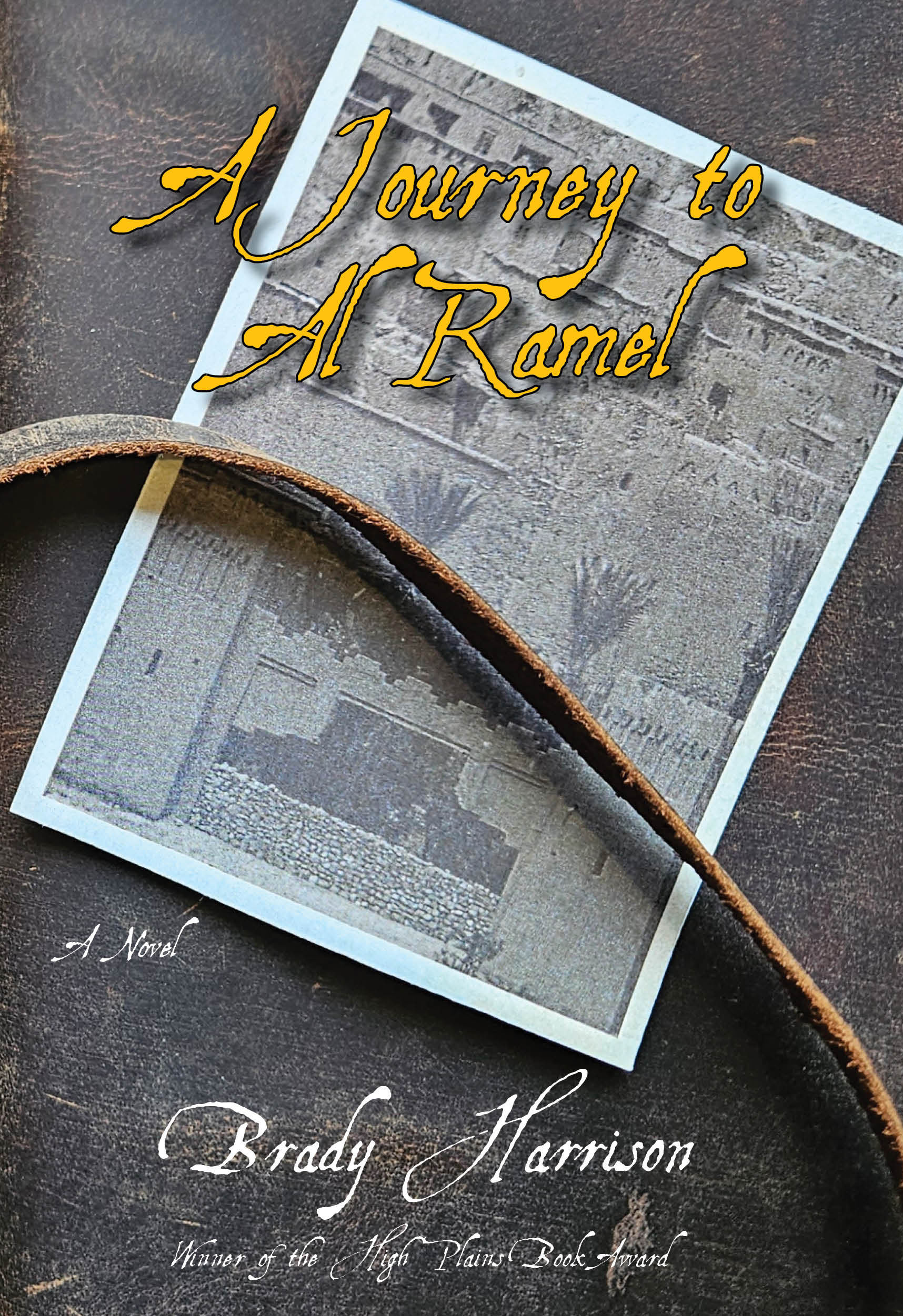
A Journey to Al Ramel was released by Twelve Winters Press in 2025.
▪ ▪ ▪
Brady Harrison’s short fiction, poetry, and essays have appeared in numerous journals, including Aethlon, High Desert Journal, The Long Story, and Short Story. He is the author, editor, or co-editor of several books, including the collection The Term Between and the forthcoming novel A Journey to Al Ramel. He lives in Missoula, Montana. Visit Brady’s webpage.
journal | team | miscellany | podcast | home
 Twelve Winters