
journal | team | miscellany | podcast | home
Gone with the Swallows
Sante Matteo
Childhood – Swallows Soar
We—the boys, not the girls—made our own slingshots every summer. First, we had to find, break off, or cut a Y-shaped twig that could fit into a boy’s hand. Then, if we didn’t have an elastic band left over from the previous summer, we carefully cut out the elastic drawstring from the underpants that our mothers had sewn for us. And then, we would fasten the ends to the notched points at the top of the V.
Armed with my slingshot, I was ready to join my friends in shooting at all kinds of targets, stable and mobile. But our favorite targets were our town’s resident swallows. We would aim at them all summer long. I say “aim at” and not “shoot” or “strike” because swallows were really hard to hit—or, more like, impossible! In fact, I don’t recall any of us ever hitting one. But, that’s what made it challenging and somehow compelling: sort of like “to dream the impossible dream, to fight the unbeatable foe,” as a song that I wouldn’t hear till much later put it.
Their nests under the overhangs of the roofs of our homes were fixed, unmoving targets, but they were off limits, because, if we missed (and we almost always missed, and were quite sure to miss hitting such small targets so far up!), we might hit and break a window. And then, we would not only be punished for breaking the window—a major crime, with glass a precious commodity not readily available in town—but there was also the risk that our mothers would find out that we had ransacked and despoiled our precious underpants, over which they had spent time and money, since they made all our clothes: outer- and underwear, and the materials were costly and hard to get—there were no stores, and most goods were purveyed by travelling salesmen who only occasionally passed through town, hawking their wares out loud, or all gathered together once a year for a one-day open-air market in the town square.
So, the nests were strictly off limits, which left the open sky, outside the town limits, away from houses and windows, where the swallows darted busily about all day (I don’t recall ever seeing them perching in trees or shrubs). But, there was little hope that we would strike one in the sky, either, because they flittered and fluttered about so crazily. They acted as if they knew we were trying to hit them, and were tempting us to try, and were then making fun of us for missing every time.
But, that’s what made it fun: the challenge of trying to hit a moving target that was gliding smoothly through the air one moment and then skittering crazily back and forth the next. Plus, the whole time, those skittish swallows would be twittering and screeching shrilly, as if they were yelling and laughing at us: “Forza, ragazzi! Come on, boys! Can’t you do better than that? Tee, hee, hee!” How could we resist?
And then, come fall, when it started to get cold, all those swallows up and left. Every one of them! The sky became empty and quiet. Days became shorter and colder. The slingshots were put away.
And that’s also when we had to change to woolen winter underwear, and when our crime of sartorial mutilation would be discovered, and we had to find a way either to reassemble our summer underpants ourselves (about as likely as hitting a swallow!), get an older sister or female cousin or friend to do so secretly, or concoct a plausible excuse to explain to mamma how they came to be de-elasticized.
The swallows (and summer underwear) wouldn’t come back until spring, when we, too, would venture back out into the streets and the fields for longer excursions, after being cooped up all the long winter—and with a new set of summer underpants, with a new elastic drawstring, at the ready.
Where had they been all that time? My grandfather explained that all our swallows went to Africa for the winter and flew back to Italy for the summer; and in many cases, the same birds returned to the same town and the same nests: “coming home to roost,” as they would say in a language I didn’t yet know but would come to learn later. He called it migrazione, migration.
I wondered why those birds would do that, especially all of them together, every single one, and all at the same time and to the same places. It seemed like such a long, long way to go. Africa! To me, the name “Africa” evoked a different world altogether: elephants, lions, gorillas; masks, loincloths, spears and arrows.
Did the swallows just get sick and tired of boys shooting stones at them, even though we could never hit them? Or, was it the opposite? Did they like that sport, too, as much or maybe even more than we did, so much so that they flew to Africa, where it was sunny and warm when we were buried in snow, and where there were African boys to take our place and who would also sling pebbles at them, which they could continue to dodge frenetically?
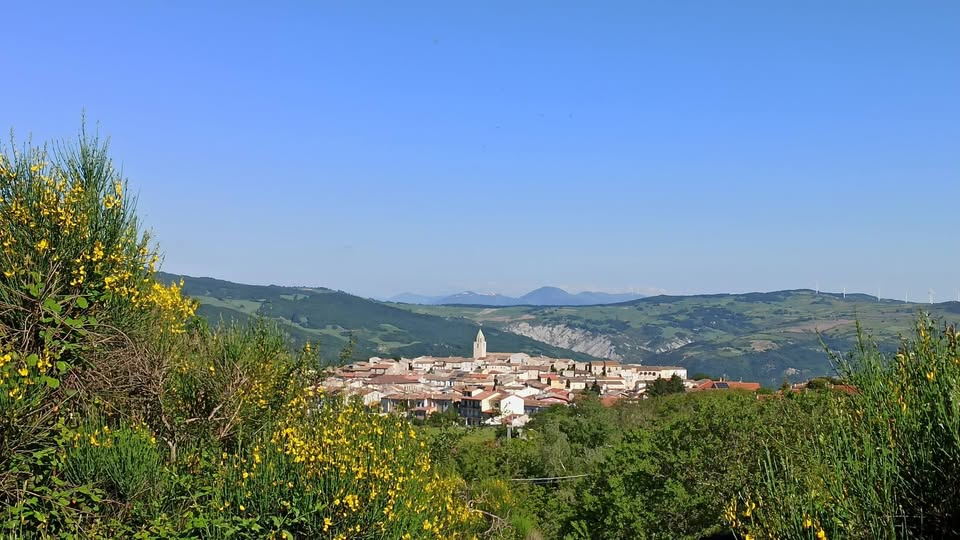
I also wondered where those summer swallows of ours really “belonged”: here or there? Which was their “home”: Petrella, my own hometown in southern Italy, or some African boy’s town, whose name I didn’t know and probably couldn’t pronounce, somewhere on another continent, another world? Were they Italian swallows that went to visit Africa, or were they African swallows that came to visit Italy?
Could their habitual and apparently compulsive “migrazione” also explain why they scuttled around in the sky so erratically: because they were never sure where they were or where they wanted to be, and so, zig-zagged in different directions, this way and that?
Or, on the contrary, was all that acrobatic zigging and zagging through the sky simply a demonstration of their innate skill of flying and their mastery of the ability to shift direction on a whim and head wherever they wanted, whenever they wanted? If they could switch direction like that in the sky, within the space of inches and feet and the span of a few seconds, maybe it showed that they also deployed the same innate abilities when heading in opposite directions on a much bigger scale, in the space of hundreds of miles, across seas and continents, in the span of many months: migrants of both micro- and macro-migration across space and time. Maybe migrazione meant that all those caught up in it, all “migrants,” people as well as swallows, had to learn to switch directions, to move back and forth, to look ahead and look back, constantly, every minute and every year. But why? Because they were forced to do so, or because they wanted to do so?
Childhood’s End – Swallows Gone
AND THEN, another change of seasons and another migration took place. Near childhood’s end, as I was about to embark on my second decade, when one season of my life, childhood, was about to turn into another season, adolescence, I, too, ended up migrating. Leaving my own “nest” for parts unknown was not by my own free choice, of course. It was a decision made by my parents, by a choice that was freer than mine, but not completely free. In the aftermath of World War II, they, along with many others from our region, were propelled to emigrate by economic and social forces beyond their control, rather than by personal whim or volition.
I then wondered, as I was about to leave and lose my home, headed for who knew where: Did each swallow—especially the ones born in Petrella during the spring or summer their parents spent there—choose to migrate, or were they all driven to do so together by some force beyond its control—flock behavior, nature, instinct, or what today might be called genes?—whether it wanted to or not?
What about us? Were we like swallows? Was I now just like one of those little swallows I tried to shoot out of the sky? Would I have to avoid slingshots aimed at me along the way?
Our journey, my family’s and mine, did not follow the same route as our swallows, over to Africa, across a relatively small sea. No, our flight took us much farther, across a vast ocean to an even more distant continent: America.
Our migration also took us across a vast ocean of time: from the Middle Ages to the Space Age. The “roost” we left had not changed much over the centuries. We left behind centuries-old stone homes, with no plumbing, no appliances, no media or electric devices (other than light bulbs and radios in a few homes; no phones or television sets); but with a few wagons and carts, donkeys, some sheep, and many goats. It was a place where agriculture, daily activities, customs, rituals, and traditions were still practiced as they had been for centuries.
From there, we migrated to a world whose inhabitants were not looking down at the land to be cultivated, but up toward outer space, beyond the sky of the swallows. We arrived in America in June 1958, as the Space Race was taking off, a few months after Explorer I was launched into space by the USA, in January 1958, following the launch of Sputnik I and II by the USSR the year before. Instead of swallows, these new American skies had rockets flying through them. No slingshots called for,
In this unfamiliar land, we found a strange new world of houses built of wood, and indoors, something called “plumbing,” with running water in the kitchen—and, not only cold, but even hot, straight out of the tap, without having to heat it in the fireplace!—and, wonder of wonders, indoor toilets!–good thing, too, because there weren’t any open fields around for that purpose!—plus contraptions called “appliances,” and bare-foot-inviting carpets on the floors, some of it wall-to-wall (not only unheard of, but not even imaginable!); all surrounded by green expanses called “lawns”—that, I soon discovered, had to be mowed, and yet, rather bizarrely, were also fertilized to make the grass grow faster and taller so that it had to be mowed more frequently and with more effort—since the contraptions used for that purpose back then were all muscle-driven push-mowers—and shrubs, and flowers; and alongside some of those lawns, there were smaller buildings called “garages,” with real motor cars in them! And, the most magical apparition or miracle of all: television! It would have all seemed like a world straight out of science fiction, had I read any science fiction, or even known what it was.
It was early in June when we arrived in this fantastic new land. Back home—or what used to be “home”—in Petrella, when we left, the swallows had already been back for over a month. I expected to find swallows in this “America” place, too, where we had made landfall: Quincy, Massachusetts, just south of Boston, where my father had emigrated several years earlier with a work contract, as a skilled craftsman in the marble industry. He had applied to have the rest of the family join him several years prior, but there was an immigration quota system in place that restricted the number of immigrants from southern Europe who could arrive each year, and we—my mother, my younger sister, and I—had to wait several years before we were authorized to join him. The summer swallows I expected to fill the skies—wondering if they tweeted in a different language or with a different accent—were nowhere to be seen.
Or, if any swallows were there, I didn’t see them; maybe because I didn’t go out to look for them, maybe because I didn’t yet have a squad of friends with slingshots with whom to go on the hunt for them; or, maybe, and more likely, because I was too engrossed and mesmerized by the world of cowboys and private eyes I saw on that magical TV screen, and I couldn’t be bothered to pay attention to the strange new world outside, where the busy streets had cars, and buses, and trucks running through them, instead of goats and donkeys; and stores and other unfamiliar places where people spoke a language I didn’t know.
But, it was just as well that I found no swallows to “hunt” in this America, because my mother no longer had to sew my underwear herself, but could buy it ready-made in the “bargain basement” of the huge Bargain Center discount department store in Quincy Square, only a 20-minute walk from our new fantasy-laden American house; and those new “American” underpants didn’t even have a detachable elastic drawstring I could remove to make a slingshot.
And that, too, was just as well, because ransacking my hand-sewn clothes to fashion a slingshot would no longer have been necessary: first of all, because there were things called “rubber bands” readily available in this strange place, but even more amazingly, because there were ready-made, ready-to-use slingshots for sale in some of those places called “stores”—a term we had to incorporate into our dialect, which remained our daily language, in a mutilated English form, “u shtor,” adapting its pronunciation to fit into the sounds of our dialect (or, to “migrate” from language to another!?), since it couldn’t be translated, because there were no such things as “stores” in our town, and thus no word in the language to depict such a thing; and we had to do the same thing for other items that hadn’t existed in our previous daily experience: u car, a giobb (job)), a fatt’ree-uh (factory—even though fattoria exists in standard Italian, and means “farm.” The term was not used in our dialect, in which agricultural fields were called camp: u camp, singular, or i camp, plural), a shtoof (stove), a fr’g’dehr (refrigerator), u sink, and of course, a television.
In place of a slingshot, now that I had discovered the wonderful world of television and of the Westerns that dominated the TV landscape in the late 1950s, I somehow managed to trade for or inherit a cap gun—certainly not purchased openly, because my parents would never have authorized such a frivolous waste of hard-earned pennies. Slinging a gun! A gun-slinger was so much more “American” than a slingshot-slinger! Now, I could shoot at “bad guys” instead of swallows.
And so, the swallows that danced in the sky-ballets of my childhood ended up taking wing and migrating over a different sea to another continent altogether: soaring across the expanding sea of time to the receding shores of “Yesteryear.”
Childhood Remembered – Swallows Recalled
IN SUBSEQUENT YEARS, I have returned occasionally to my hometown, finding that the swallows are still there, as numerous and as agile in flight as those of my childhood, gliding gracefully one moment and darting sharply the next, and still migrating seasonally to and from Africa.
And yet, they are not the same as the swallows of my childhood that I recall; and, not only because those died many swallow generations ago and have been replaced by their descendants, but because their swallow-ness or swallow-hood is different.
Now, with adult eyes that have seen more of the world and more of life, I can gauge that they fly much too high for our children’s slingshot-flung stones to reach them. We never came close, not because they dodged our little missiles, but because the puny missiles gave up and turned back to earth way before they reached their intended targets.
Furthermore, I now know that they flit about and switch direction rapidly to forage for flying insects, not because little boys with sagging underpants are shooting at them with their home-made little catapults. Their shrill whistles, tweets, and screeches, I now realize, are not to taunt and mock little hunters slinging little missiles at them in vain, but to communicate with each other about where they are, where they’re headed, what they’ve found: what to seek and what to avoid.
And the little boys I now see in my hometown are also different; and they, too, not only because they are distinct descendants of the boys of my generation, but also because their boyhood is different from ours. They don’t carry around handmade slingshots, nor wear handmade underwear sewn or knitted by their mothers. Instead, they wear store-bought underwear and carry store-bought electronic gadgets. Most of the time, they look down at a small screen in their hand, not up at the big sky above them: across different horizons.
We are all migrants. Even those who don’t migrate from one place to another, whether from one continent to another, or from one town to another, are forced to migrate through time, season to season, year to year, decade to decade, generation to generation.
And so, the swallows of Petrella continue to migrate, and I do, too, albeit I do so occasionally, not seasonally or regularly. And, like the swallows and the boys of Petrella, I am and am not the same as the little boy who loved shooting at those darting birds and missing them, over and over.
Still, and again, those swallows of my childhood and those little boys with the improvised slingshots continue to populate a part of my world, and they continue to migrate back and forth: birds of passage between past and present, darting and zig-zagging through my memories. And, I still miss them—now, in more than one sense of “missing.”
Swallows leave, come back, leave again, come back again, leav . . . .
▪ ▪ ▪
Sante Matteo was born and raised in a small agricultural town in southern Italy and emigrated to the United States with his family as a child. He maintained his ties to Italy as a professor of Italian Studies. He is currently Professor Emeritus at Miami University, in Oxford, Ohio, where he resides, reminisces, and writes. Stories, poems, and memoirs have appeared in various journals, including previous issues of Twelve Winters Journal. Some can be found on his website: santematteo.com. Read the author’s commentary on his piece.
journal | team | miscellany | podcast | home

