
journal | team | miscellany | home
Craft Essay 2:
The Imperative of Powerful Language
Ted Morrissey
For this essay I want to focus on writers’ tools; that is, devices and techniques that writers can use to not only make their writing effective, but memorable. This topic includes the use of literary devices, and therefore it speaks to the core of my sensibilities as a writer, reader and teacher of writing. In fact, recently I delivered a paper at a conference in Singapore titled “Beauty Must Come First: The Short Story as Art Made of Language,” based on the aesthetic theories of my literary idol William H. Gass. My primary focus tends to be writing fiction, but I firmly believe that all genres benefit from the use of powerful language: fiction, poetry, creative nonfiction, screenwriting, drama.
In fact, it is the thing that binds all creative writing: the need to use language powerfully.

Here’s a link to the paper I presented, but also here’s the abstract that gives the paper’s gist:
Fiction writer, essayist, critic and translator William H. Gass (1924-2017) – recipient of numerous accolades, including Pushcarts, Best American Stories, an O. Henry, the PEN/Nabokov Award, and American Book Award – said that his sole responsibility as a writer was “to the language I’m using and to the thing I’m trying to make.” Gass’s attention to his language, to its style, was paramount in his fiction because “when language is used as an art it is no longer used merely to communicate. It demands to be treated as a thing.” As such, Gass was less concerned with narrative elements that most other writers tend to grant supremacy, elements such as plot, characterization, and setting. He wrote, “In every art two contradictory impulses are in a state of Manichean war: the impulse to communicate … and the impulse to make an artifact out of the materials of the medium …” Gass believed the latter was the superior impulse for all artists, including writers, but yet the one more difficult for readers to comprehend and appreciate. Gass’s emphasis on the construction of language over the construction of plot or character made some critics view his fiction as prose poems more so than traditional prose narratives. In my courses (literature courses in, for example, Shakespeare, Joyce, and postmodernists like Don DeLillo, David Foster Wallace, Shelley Jackson, Eurydice, and Gass), one of my overarching objectives is to make students more mindful of language. My sense is that in workshops there is significant attention paid to the mechanics of fiction (plot, characters, setting), but less paid to the stuff that makes all of it: language.
Gass outlined his recipe for literary achievement, which I’ve represented in this meme:
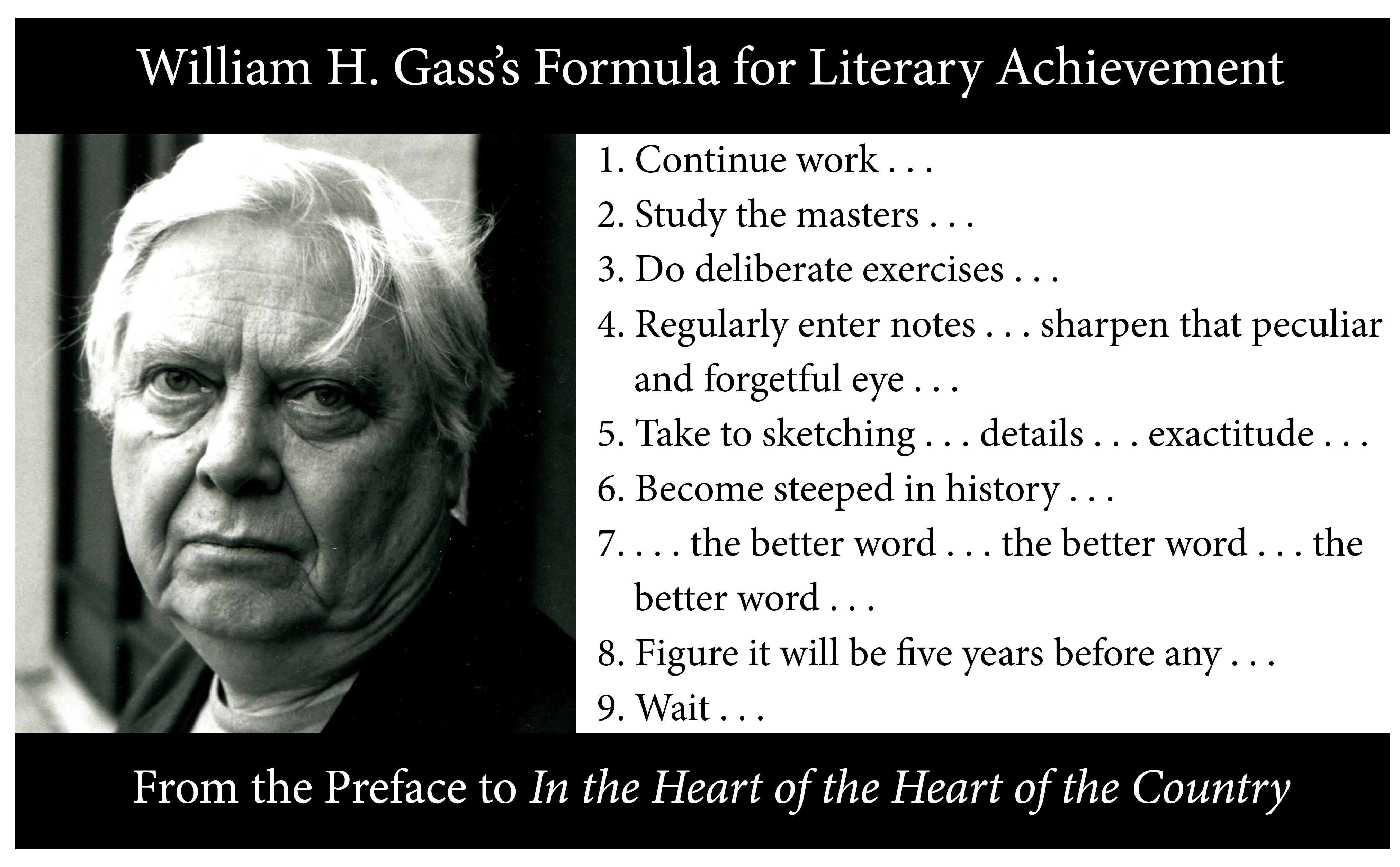
There is much here to discuss, but I’ll call your attention to number-7: “. . . the better word . . . the better word . . . the better word . . .” by which Gass meant that a writer — no matter what they’re writing — must constantly be in search of the right words, the most effective use of language.
The textbook Creative Writing: Four Genres in Brief has a useful section that relates to this concept: “Images, symbols, and figurative language” (4th ed., pp. 41-49). David Starkey includes it in chapter 1, “Writing Poetry,” because we often think of these concepts as being associated with poetry. However, there’s no reason that we should limit their use to poetry. All writing benefits from the poetic use of language. Starkey offers sound advice on the use of imagery, which, again, pertains to all forms of writing: “As you consider images for particular moments in your [piece], it’s important to realize that the more specific the image, the more likely it is to be remembered. Moreover, an image that is unusual yet appropriate is even more likely to make an impression on your readers” (p. 45; italics in original).
So as we move forward with our writing — regardless of our chosen primary genre — being mindful of language and trying to make it as poetic, as memorable as possible should always be one of our concerns. Oftentimes, in a first draft I’m not always able to keep that juggling pin in the air, meaning that I may just focus on representing the idea or the action clearly. Then later, when I revise (and revise and revise), I will try to turn up the heat with effective imagery, unusual diction, and outside-the-box similes and metaphors.
I feel that David Starkey has some useful things to say about symbolism as well, which is the focus on this brief video:
▪ ▪ ▪
Ted Morrissey’s novel excerpts, short stories, poems, critical articles, reviews, and translations have appeared in more than a hundred publications. Among his award-winning novels are Crowsong for the Stricken, Mrs Saville, and The Artist Spoke. Delta of Cassiopeia: Collected Stories and Sonnets was released in 2023. He is a lecturer in Lindenwood University’s MFA in Writing program, and also teaches creative writing and literature courses for Southern New Hampshire University. His craft essays have been culled from his lecture notes. Visit tedmorrissey.com and follow on Twitter @t_morrissey.
journal | team | miscellany | home
 Twelve Winters