
“Works of the Flesh” is Strophe XI in The Strophes of Job, and it is presented here in conjunction with a reading at Chicago Public Library’s Albany Park Branch, Sept. 19, 2024. It was first published in the anthology The Road Not Taken: A Global Short Story Journey.
Context:
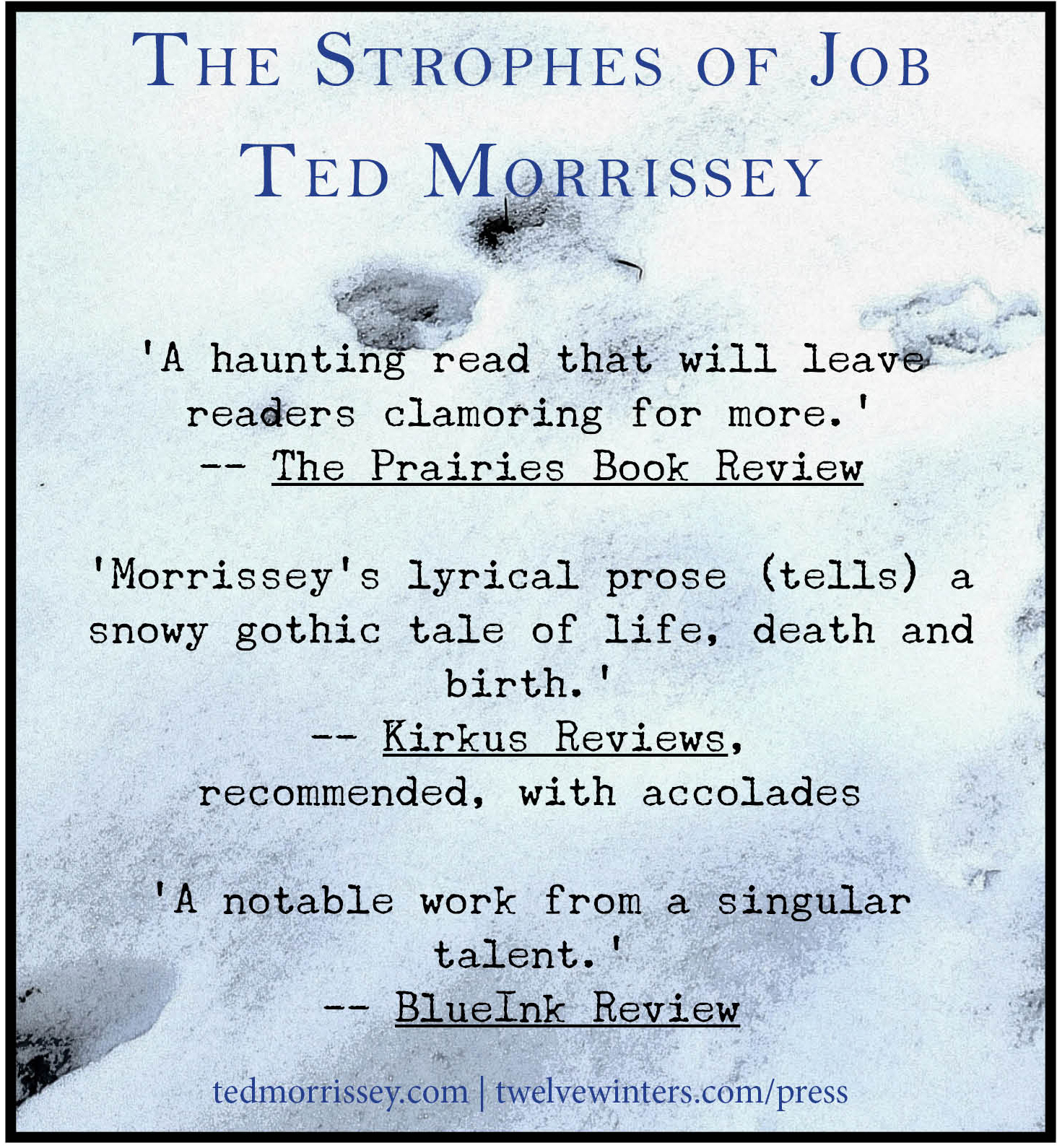
It’s 1907, and a terrible snow storm rages across the midwest, burying a rural community but also revealing its citizens’ closely guarded secrets. Two farm families — the Johnsons and the Fryes — struggle while their women fight to give birth during the storm. The only midwife in the county must decide which mother and which baby to help, if she is able to make it through the deepening snow at all. The difficult and dangerous births force a host of people to risk going out in the storm, which has turned the familiar countryside into a strange and confusing landscape. Meanwhile, the snow storm has emboldened a band of coyotes that normally stays close to the mysterious and forbidding Hollis Woods, where thirty years before the Hollis children disappeared one by one without a trace. Their ghosts haunt the woods still, say locals. But it seems everyone has a past that haunts them, and the relentless storm provides the perfect canvas for painting memories and images best left forgotten. The Strophes of Job is a prequel to the multi-award-winning Crowsong for the Stricken, a Kirkus Reviews Best Indie Book of 2017 (“strange and beautiful,” starred review).
Peggy’s hand shook as she used a rag to wipe Sarah’s soaked brow. A candle burned low on the side-table even though it was daytime. A remnant of the previous night’s vigil, Peggy had neither the energy nor the will to extinguish it. She felt every second of her firstborn’s anguish but had lost track of the hours. Sarah watched her mother’s hand as if a thing all its own and not a hand that held her as a baby, that comforted her countless times, a warm, outstretched extension of maternal love. Now the rag might have been borne in the lifeless twigs of a broken branch, reaching in from beyond her bedroom window.
Sarah’s showing no sign of recognition made even more unbearable her daughter’s agony. The baby who seemed so impatient to be born throughout Sarah’s pregnancy, so desirous to release its wrath upon the world, was breech and unable to free itself from uterine captivity, from the detainment of its mother’s young womb, where it railed against its arrest night and day with little more than a moment’s break in the torment.
Peggy looked out Sarah’s window to the unending white. A snow storm had been battering their world for more than a day and probably accounted for the midwife’s delay. At first Peggy tried to keep Sarah’s situation from everyone, including Emma Houndstooth, the midwife, but it promised to be a troubled pregnancy from the start, so Peggy brought Emma into the deception she had invented, that she was the one who was pregnant, and beautiful, dutiful Sarah had withdrawn from the world to help her mother on the farm. The baby would be hers and Nord’s, and Sarah merely the devoted eldest sister, a second mother—a white lie that would give Sarah her life back and erase the unthinkable, make the violation and the violence simply vanish. The ticks of time taken back, the world made right.
Emma, along with the whole Johnson family, was sworn to keep the secret forever. In some inner chamber of her soul, some dark closet of the heart’s dungeon keep, Peggy feared it couldn’t be done. She refused to acknowledge that distant, disquieting voice. The course must be stayed. Everything must work out even against the longest of odds.
Surely Mrs. Houndstooth had some technique, some rare trick that could reposition the baby and allow the birth to proceed as nature intended. Peggy tried not to think of Emma’s recent record. She had not presided over a birth where both mother and child survived for more than a year, nearly two. Before this spate of deaths, Emma’s twenty years of midwifing with only the rare loss had made her as necessary at the birthing bed as a sharp set of shears for the cord and a welcoming blanket for the newborn. She had almost singlehandedly put Doc Higgins out of the delivery business, a demotion for which he was sincerely grateful.
Of late, however, Emma Houndstooth had become the opening act for the undertaker. Surely, though, her bad luck had run its bleak course; and Mr. Michaels would have to seek his clients elsewhere.

Peggy wiped Sarah’s forehead. Her daughter shifted her weight and turned away from her mother. Peggy knew she was searching for a more agreeable position, yet the move nagged at her nevertheless. She again gazed out the snow-struck window. The white was blinding to her tired eyes. She shifted her sight to the old henhouse in the yard, and at first she thought she saw an animal at its door, a coyote worrying its rusty hinges—but, no, it was the boy, Billy Holcomb, in a dark coat and fur cap, the boy everyone who knew mistakenly believed had gotten Sarah with child. Sarah had confessed the truth to her mother, and Peggy decided then and there, holding her sobbing daughter, that the truth would go no further. It would only go away.
Let Nord and the children and Emma Houndstooth assume it was a childish mistake, an indiscretion born of ignorance as much as youthful passion, or Billy’s unpracticed persuasion. The guess was better than the truth, and easier to erase, easier to replace with the new truth that the baby was Peggy’s, that she and Nord had had a time (let folks snicker, let Pearl Anthony make her snide remarks) and a late-in-life blessing was the balm for their embarrassment.
Peggy felt for the boy, brokenhearted and burdened with the lowliness of his clan, but he would survive it and soon enough another girl would fall for his twisted-tooth smile and shy, unpolished ways. Billy watched up at Sarah’s window, and Peggy thought perhaps she and the boy had found each other’s gaze. They had an understanding, she believed: Billy knew the truth too but shame would silence him.
Sarah screamed and shifted in bed, and Peggy turned from the window. It was an awful spectacle. To think, the pitiful, sweat-soaked creature that writhed in pain, only a few months before was her sapphire-eyed daughter, whose golden daffodil hair and room-igniting smile attracted boys like bees, Nord always liked to say.
Peggy internalized the story to such a degree—the story that she was the Johnson who was pregnant—she could feel the violent little life growing inside her. At first only shudders of movement, easily dismissed as the bloated groaning of an irritated bowel, a nerve-knotted gut. Then, weeks later, pointed kicks and the punches of curled fists. The advancing signs mirrored Sarah’s growing woes. Sarah, though, had begun to show, in spite of her dresses’ pleated skirts and the apron she wore ubiquitously, whether there were kitchen chores or not. A bulge then a ball then a great barrel of a stomach. Meanwhile, Peggy, always a slight woman, grew thinner. She wasn’t hungry, and the smell of food, even her favorites, made her nauseous. She continued to cook for the family but every meal fostered a fierce stomachache that sat leadenly at the base of her throat. Every second was a struggle against the urge to rush to the privy and purge her suffocating pain, except there was nothing to deposit in the putrid dark hole. She was subsisting on sips of tar-black coffee and nibbles of crackers.
As the months continued their creeping pace, and as Sarah grew larger and larger, Peggy steadily shrank toward a skeletal form. What hair didn’t fall out turned a ferric gray. Her only feature that seemed to get bigger were her eyes, which used to be blue (as blue as asters Nord had said once, in a rare fit of flowery tenderness), but they had grown as gray as granite and were just as stony.

She sometimes thought of the girl in that funny story, Alice, who drinks a potion that turns her small. For more than emaciated, Peggy felt herself shrinking in every way. Shrinking and shrinking. The kitchen sink seemed taller, the privy seat higher, her husband, truly a tall man, was becoming a giant, a freakishly massive fellow from the pages of a fairy tale. Jack’s raging giant. Nord frightened her. The world frightened her.
Once the baby was born everything would be right again. There was no purpose in believing anything else. She’d always been strong-willed, flinty, she knew people said, shrewish too had been used on occasion, and this newfound fear had toughened her further. Nord demanded to know the truth about the father of Sarah’s baby, fumed and fussed, pounded about the house and pouted, but Peggy’s tongue wouldn’t budge.
The sooner Nord became used to the idea that he was the baby’s father the better, even if he felt as betrayed as Joseph by the veritable virgin birth. For all that Nord needed to know, the child could be as fatherless as the Savior—though in the womb it seemed no lamb, more the ravenous wolf impatient to sink its lethal teeth into a defenseless flock.
Peggy reached up to adjust the curtain on Sarah’s bedroom window and found she couldn’t reach the rod. Surely she could before. Further evidence of her increasing miniaturization, more proof of her growing diminishment. At this rate a leg will be caught between the child-wolf’s teeth, as annoying as a broken wishbone lodged between eyetooth and incisor, when it gobbles down its grandmother . . . rather, its mother.
Sarah groaned and grappled and grimaced with the breech baby who would just as soon rip its way into the snow-broken world impatiently awaiting it.
If Emma didn’t arrive soon and work some magic of midwifery, there would be no choice but to cut the entombed baby from doomed Sarah’s suffocating womb. It was a simple and natural fact on the farm, each foaling and calving season; every spring lamb may be the death of its luckless ewe.
Among such recollections was one of her father gutting wolves in the barn, three beasts of iron-gray fur hanging upside-down from a beam. Their offal was accumulating on a heavily soiled canvas sheet. Even in death, their yellow eyes and weirdly white teeth seemed to cast their own menacing light in the relative gloom. Peggy, not yet ten and half the height of the most diminutive wolf’s length, feared their bite even though she knew it was quite impossible, with their guts and hearts and livers spilled unceremoniously to the dimly lit floor. Still, that night, as she lay in her little bed, Peggy believed she heard the ghastly pack howling plaintively from their ropes, gently swaying in the dark, their fur curing in the cold.
She imagined Sarah’s baby as a half-wild creature who would try to bite whatever hand worked to wrench it into the world. The howling that had been in her ears more than a day, for a moment, was not the snow-choked wind but the being who thrashed and clawed inside treasured Sarah, bathed in sweat in spite of the room’s bitter draft.

A second or two of silence were filled by a racket downstairs: the kitchen door shutting hard and a heavy sound from the outdoor steps. Peggy watched out the window knowing her husband would come into view. Billy Holcomb retreated farther behind the henhouse. Sure enough, Nord staggered into the scene. The snow was deep, which added more awkwardness to his already whiskey-addled gait. He was headed to the barn, out of view. Maybe Nord would saddle Samson and see if he could track down Emma Houndstooth. It’d be a better use of his day than drinking himself blind on a throne of hay bales, golden in the snowlight.
Sarah experienced a fresh wave of pain, and her agony shattered the cold air with a sound that straddled a line between human and animal. Perhaps she tried to form words but they were as unintelligible as growls and howls and the trumpeting of trunked creatures—scenes from the only circus Peggy ever attended broke the surface of her memory, startling in their sharpness, as if experienced only last week and not decades before, her father at her side but unwilling to hold her hand in public in spite of her uneasiness. In public places her father’s icy demeanor became several degrees chillier, and nowhere was he more distant than church. Maybe he listened to the pastor’s sermon but his gaze, his whole being, appeared fixed on Jesus on the cross, whose agony loomed over the altar like a black cloud threatening to unleash a tornado, an instrument of destruction that would sweep the entire congregation into a fiery pit everlasting.
A crucifix hung on the wall above Sarah’s bed. It had always seemed a small symbol made of dark-stained wood. Now, however, it had grown and appeared too heavy for the old nail that suspended it above Sarah’s bed. Christ himself seemed too big for the pieces of timber that held him to his torture. He was a giant Christ whose weight should splinter the spindly sticks of the cross. Even his suffering was enlarged, the agony on his hand-carved face more acute, the anguish of his notched eyes more intense, the angled spear-opening in his ribs more raw.
Peggy wanted to pluck the grotesque figure from the wall before it fell upon beloved Sarah’s head, except it looked too high to reach (though she herself had hung it there twenty years before). Peggy’s own labor pains lightning-fissured through her torso, causing her match-stick arms to recede out of reflex, a spasm that caused her hands to protect the place where her real babies had been.

It occurred to her that in an earlier time she would have prayed, quite naturally, quite automatically, for the baby’s safe birth and Sarah’s survival, but throughout the entire ordeal of the pregnancy Peggy hadn’t prayed once. She never even thought to request God’s intervention. At some point in her life she’d stopped believing. There was no dramatic moment, no sudden burst of white-hot clarity. Her belief, which perhaps was never complete, had drained away, drip by drip, without Peggy taking notice. She continued to go to Sunday service and to play the role of a believer, but it was pure habit and the meeting of community expectation. When Sarah became pregnant and Peggy withdrew from public sight in accordance with the story that spontaneously came to mind, there was a subtle sense of relief. For a while at least she could give her hypocrisy a rest. She wouldn’t have to wander her mind for more engaging thoughts while Pastor Wilson spun sermons of nonsense from the pulpit. She would no longer have to entertain him in their parlor every few weeks. She would no longer have to tolerate his blotchy red cheeks and nasally voice, his smell of wet wool and cheap sacramental wine. She would no longer have to feign interest in her neighbors’ gossiping, have to smile at Pearl Anthony’s clever and cutting remarks about whomever wasn’t present at the moment. She would no longer have to mumble through chapter and verse pretending to find meaning and comfort among the dust-covered stories, the parted sea, the pillar of salt, the plague of the firstborn sons, or, for that matter, the entirety of the Passion.
Suddenly it was as plain and as stark as the storm that buried the land in unrelenting, unrepentant snow: There was no one to help her help Sarah and the baby. The weight of the world fell upon her shrunken shoulders, though she felt its pricking thorny point in the top of her head, as if the whole of everything were balanced there precariously—and any movement may cause it all to come crashing down in a blaze of dust and trumpets.
Peggy took one last look out the window, at the vast and colorless void, blew out the meaningless candle, then reached for the old wooden Christ on the wall.
▪ ▪ ▪
Ted Morrissey‘s novel excerpts, short stories, poems, critical articles, reviews, and translations have appeared in more than 120 publications. His most recent books are the novels Crowsong for the Stricken, Mrs Saville, The Artist Spoke, and The Strophes of Job, as well as Delta of Cassiopeia: Collected Stories and Sonnets. He is the publisher of Twelve Winters and co-hosts the podcast A Lesson before Writing.

 Twelve Winters