
journal | miscellany | press | podcast | team
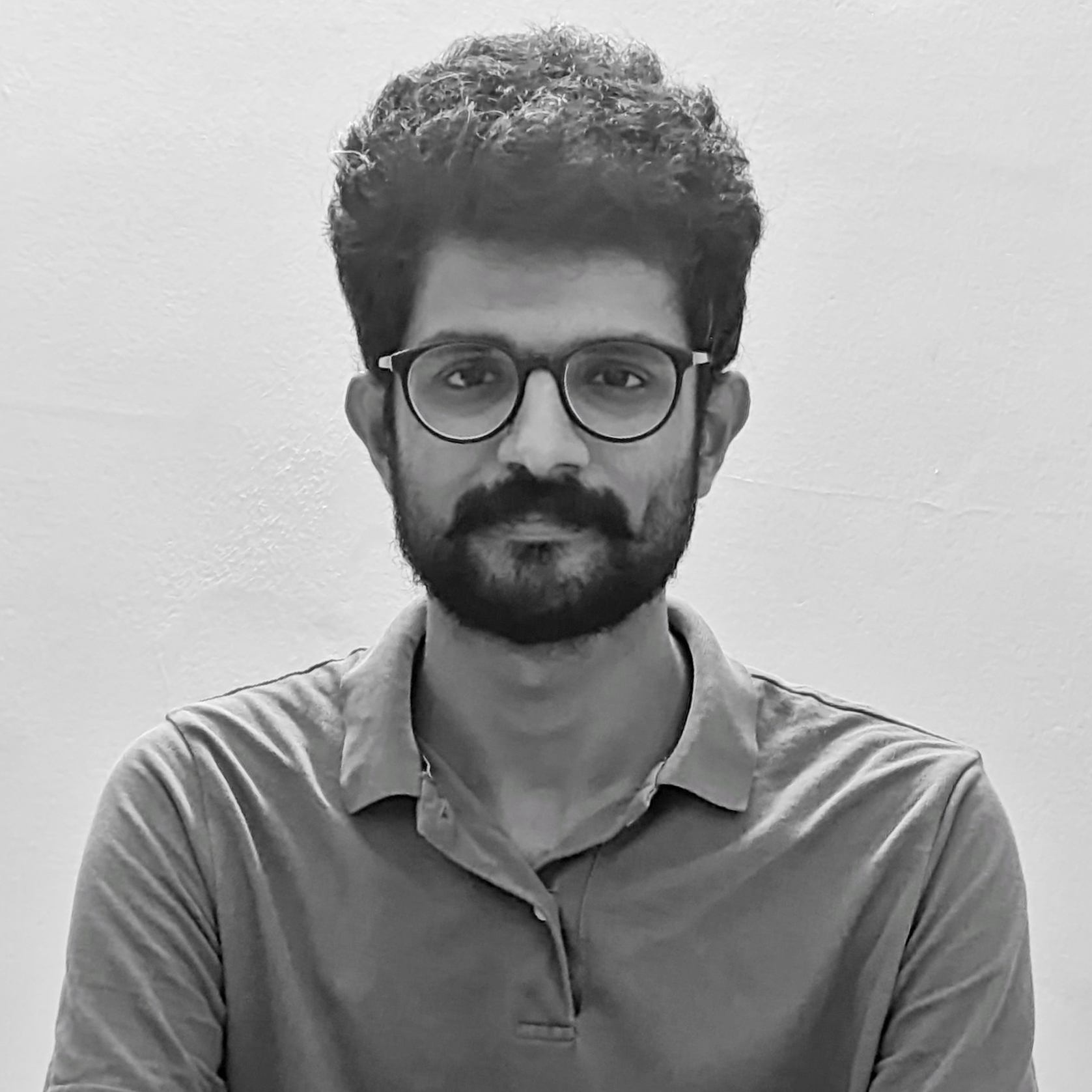
An Interview with Abijit Radhakrishna
‘I feel that every narrator is unreliable; because the more human a narrator/character is made, the more unreliable they become.’
Augustine George & Aswin Prasanth
Abijit Radhakrishna is a versatile writer from Kerala, India, whose journey into creative writing began during his school years. His passion for literature evolved significantly during his academic years, heavily influenced by world literature. Radhakrishna’s creative journey is marked by his exploration of various genres and styles, making his literary portfolio remarkably diverse. In his novel Kill the Girl (2019), Radhakrishna delves into the intricate world of crime fiction, presenting a gripping narrative set in Kochi, Kerala. During the COVID-19 pandemic, he wrote “Ride Back Home: A Micro Suspense Thriller” (2020), capturing the anxiety and claustrophobia of the lockdown period through a suspenseful short story. His historical retelling, The Lion’s Minister (2022), shifts the focus to unsung heroes, offering a fresh and compelling perspective on historical narratives. Venturing into translation, Radhakrishna has brought works like Kilimanjaroyile Manj (2023), a Malayalam translation of Ernest Hemingway’s “The Snows of Kilimanjaro” (1936), to a new audience, demonstrating his skill in bridging cultural and linguistic gaps. Radhakrishna’s short story, “Kari: A Prologue to Arikomban, the Elephant” (2023), reflects the ongoing human-animal conflicts in Kerala, highlighting the impact of human activities on the environment and wildlife. This narrative choice underscores his ability to weave contemporary issues into his storytelling. Currently, Abijit Radhakrishna is an Assistant Professor of English at Sacred Heart College, Kochi, Kerala, India, where he continues to inspire and educate through his academic and creative pursuits.
What prompted you to pursue creative writing? Could you talk about writers who have inspired/influenced you?
Imagine this: Year 2008, a boy goes to a private, English-medium high school in Kerala. He isn’t into sports, public speaking, or any arts that require standing before an audience. He isn’t dumb enough to flunk, nor nerdy enough to ace everything. He doesn’t have many friends, but a handful just like him. What would he do in his free time at school? Read, of course! Enid Blyton, Franklin W. Dixon, R.L. Stine, and so on. That pretty much sums up my high school experience. However, my reading did not start in high school. During the summer break of 2004, the one after I completed lower primary school, I would be home alone as both my parents worked, and I was an only child at the time. I wasn’t particularly brave either. I was scared to leave the living room because all the other rooms would remind me that I was alone; the living room had the TV set which would offer comfort either through Cartoon Network or my ‘100-in-1 Video Game’ (the one with Super Mario and that duck-hunting game).
Concerned about my screen time, my parents found another way to keep me engaged: books. My father used to commute to work by train and had this habit of buying ten-rupee books by H&C – those “101-Natural-Home-Remedies” kind of books – from direct salesmen. He started to buy books like Aesop’s Fables, Tales from Panchatantra, and Tenali Raman for me.I also had a subscription to Balabhumi, a Malayalam children’s weekly. So, I started reading, and that habit stayed with me throughout upper primary school and followed me into high school. It was in high school that I wrote my first creative piece, a poem, and my English teacher had read it in class. But I didn’t write much after that until I joined BA English in 2013. I started a fiction blog on WordPress, where I regularly posted poorly written short stories, mostly cheesy, tearjerker romances and revenge thrillers. In a year, I shut it down for good. At this point, I had started reading Stephen King and James Patterson, who would inspire my foray into popular crime fiction. That, and the TV series Castle, where the main character is a filthy rich mystery novelist, had a lot to do with my desire to write.
But, the actual drive to create stories came to me during my MA English days. The more I was exposed to world literature, the less satisfied I was with my writing. I cringed at the blog stories I had written and double-checked to make sure none of them remained on the internet. I started reading Franz Kafka and wondered how anyone could write volumes and want them to be burnt. Until then, my idea of writing had more to do with becoming rich and famous like Richard Castle than writing just to let the dogs out, if you know what I mean.
Kafka changed my perspective on fame – not that I’ve stopped wanting it, but at least I could see why it didn’t matter much to him, or that it is normal to simply not care about it. So, I’d say that philosophy-wise, Kafka has inspired me.
Regarding writing style, I find myself shuttling between inspirations based on the genre I’m writing. For instance, while writing literary fiction, I tend to lean more on authors like Dickens for the descriptions, Kafka for the sheer randomness of everything, and Tolkien for all the little details. But when I write genre fiction, I stick to Patterson. He writes very short chapters in his books, like two pages or less, which is the perfect business strategy. How? Well, shorter chapters keep readers engaged and eager to read ‘just one more,’ leading to increased page-turning and overall interest in the book. Before you know it, you’ve read the entire book.
Additionally, shorter chapters mean you are likely to read one during a visit to the bookstore, get hooked, and buy the copy. In one of his interviews, he mentioned that he imagines each chapter as a movie scene before writing it, which helps him focus on the central action and maintain the fast pace a thriller should have. That is great advice. It helped me a lot while writing Kill the Girl.
“Impressions: The Story of a Narrator” (2018) is about a novelist attempting to engage an audience by narrating his life experiences and philosophy. Does the story play with the idea of unreliable narrators? Is this your attempt at extrapolating the idea of a novelist as an impresario?
I’ll let you in on a secret: “Impressions” is not a complete work, but the prologue to a novel I had written back in 2018. It’s called Waking Up the Vermin; my first novel, although unpublished and just sitting in my Google Drive. And, this is the first time I am talking about it. I had intended for “Impressions” to be kind of a ‘sneak peek’ into the world of an author who thinks too much of himself (no, it’s not anecdotal!), and would do anything to prove himself. My love for the Kafkaesque, coupled with prolonged exposure to the likes of Camus, Sartre, Derrida, and Hesse during my master’s program (I graduated in 2018 and had immediately started working on this novel) prompted me to write something “high-brow.” The result? Two hundred pages of “fashionable” incoherence, where you will find a story of crime, guilt, deception, and ambition – although not anywhere near Crime and Punishment.
The narrator you meet in “Impressions” is also the protagonist, the proud author I mentioned, who remains anonymous throughout the novel. I have always been a fan of the unreliable narrator trope in fiction and this was my attempt to create something ‘deep.’ I feel that every narrator is unreliable; because the more human a narrator/character is made, the more unreliable they become. I was just having fun with this ‘author’ and his antics. I haven’t had such fun in any of the works that followed. Some of the chapters in this novel are simply lecture notes in shorthand, of the ‘author’ from when he attended public lectures on experimental literature. At some point, I considered giving the novel a subtitle, “The Anecdotes of a Conceited Liar,” although I decided not to.
The bottom line is, as readers we love characters with several layers. There is an increasing demand for narratives that show the dirt beneath the surface. This might be the consequence of how interactive everything is becoming – the passive/mute spectator is no more. So, writers/creators must leave enough cracks in their characters that readers feel rewarded when they find things on their own, which is comparable to the sense of purpose one gets while playing video games. We love side quests, don’t we? Investigating characters/narrators could be one such quest. That is what I had in mind when I wrote the ‘author’ in “Impressions” and Waking Up the Vermin.
Allow me to quote him for a fitting wrap-up of this answer: “From what you’ve read so far, you suspect that I might be an unreliable narrator. Yet, your best bet is to rely on me till the end. How twisted is that?”
Kill the Girl (2019) is a murder mystery set in Kochi, Kerala, with a female police officer as the protagonist. In what ways does your novel explore themes of justice, morality, and ethics in the context of the criminal investigation and the medical issues at stake? To what extent does the novel explore the nature of crime and the challenges faced by law enforcement in modern society?
I started working on Kill the Girl soon after wrapping up Waking Up the Vermin. It was initially planned to cleanse my palate of the pungency of literary fiction by getting busy with something light and ‘pulpy.’ It took me six months, a few calls to some policemen and doctors, and a whole lot of research on Google to finish my first investigative/medical thriller. I also had some beta readers who gave very insightful comments. Now, to answer your question – while also trying not to give any spoilers – I’d say this novel navigates the complexities of a female protagonist in a male-dominated professional environment while weaving in the ‘sinister corporation’ trope to evoke a sense of paranoia akin to the novels of John Grisham. There is a common belief that larger systems tend to become more corrupt or sinister. So, all I had to do was say that the hospital is big and rich.
That is, sometimes you just need to place the context before the reader, and the story writes itself. Kill the Girl is a relatively short novel: at around 180 pages, it is a story that unfolds over seven days. So, I had to make things tight. I didn’t have the luxury of giving detailed accounts of the patriarchy at work or the eeriness of the ‘evil’ hospital. These elements are part of the larger scheme but are not directly relevant to the main action. So instead, I outsourced the work to my readers: they knew Wahida Ali, the protagonist, was facing chauvinism at the workplace without me having to spell it out in each chapter. The same goes for the hospital. My readers knew something was not right about the place when they read two sentences about its cold walls and squeaky-clean floor. That way, I got to work out the twisted plot while they read between the lines.
I had a harder job: to keep readers glued and guessing. I was under the impression that writing a plot twist would be a cakewalk, but boy, was I wrong! Because if you can guess it, the readers probably can too. That is when I made an infographic (although not as cool as the ones you see in the movies) and pasted it on my bedroom wall to find all possible connections between characters, places, and contexts, while also identifying suitable red herrings. I guess it worked to some extent because so far, only one reader – who also happens to be a mystery author based in Kolkata – has told me they saw it coming. Either that or the others were too nice to hurt my feelings.
On a different note, I regard Kill the Girl as a tribute to two strong systemic pillars that make our lives worth living: law enforcement and healthcare. We can’t thank them enough. I’ve tried to make their experiences as authentic as I could, but from what I’ve heard from professionals in these fields during my book research, I’m pretty sure my 180 pages don’t reflect even a fraction of their hard work.
“Ride Back Home: A Micro Suspense Thriller” (2020) was written during the COVID-19 pandemic. Was this tale an attempt to mirror the claustrophobia and anxiety surrounding the COVID lockdown with that of the protagonists?
Now this is something I wrote, in my self-invented nomenclature of ‘micro suspense thriller,’ a year after Kill the Girl. To tell you the truth, I had started to miss writing plot twists. I had written nothing significant, let alone mysteries, after the publication of Kill the Girl. In my defense, I was busy with my day job of teaching. But 2020 presented me with the perfect opportunity to get back to writing. The whole nation was under lockdown and the online class fiasco hadn’t been devised yet. So, it had me thinking…why not just write a thriller short story based on the pandemic? That’s how my eight-page thriller “Ride Back Home” was born. There are only two characters: Paul Mathews, who is driving back home past the curfew, salivating over the rice and fish curry waiting for him, and an unnamed traveler who needs a ride.
Now the story may not seem as high stakes as it did then, since COVID-19 – along with the whole pandemic experience – has become normalized. We are aware of how it spreads, and the prevention/treatment measures as well. But at its onset, the pandemic was indeed frightening. So yes, you could say that “Ride Back Home” has tried to situate the apprehensions of a new paradigm.
The Lion’s Minister (2022) is a retelling of the life and times of Kerala Varma Pazhassi Raja from the perspective of his minister Kannavath Sankaran Nambiar. What was the rationale behind your choice of Sankaran Nambiar as the protagonist? Do you think retellings are effective critiques of the canonical/mainstream historical accounts?
We know the heroes, we know the villains, but do we know the hero’s butler? I mean, someone other than Alfred Pennyworth. We don’t, for the most part. We don’t know where Arthur Fleck gets his clothes dry-cleaned and who does it for him, considering how clean they are even after the previous night’s bloodbath. But that is fiction, where you don’t always get the whole picture, unlike history which is supposed to be a definitive source of facts. Neil Armstrong is quite known to us, then, unless you are really into astronomy and space travel, the name Buzz Aldrin would not ring a bell. And, even if it does, Michael Collins will not. These are the people history tends to step over on its journey to glorify the ‘main’ heroes.
History is not the only culprit here, because even with adequate historical records on certain people and what they have achieved, the public keeps them outside the mainstream narrative. Consider the Indian independence movement for instance. Its events have been documented and preserved in the books of history, read, and taught across the nation. It is made accessible to all generations, aiming to publicize the perseverance of Indian leaders under the British Raj. But, as with most historical citations, some remain lesser known and get blurred in comparison with the celebrated names. And, even when they are documented, we overlook their stories, making them mere silhouettes. I hadn’t given much thought to these aspects until I saw a call for book proposals by the National Book Trust, New Delhi, under the Prime Minister’s Yuva Scheme. One of the categories was ‘unsung heroes’ and I decided to send one.
I began the research to find an unsung hero from my part of India, which eventually led me to Kannavath Sankaran Nambiar. He was the Sarvadikaryakar (loosely translatable as prime minister) of Kerala Varma Pazhassi Raja, who was one of the few local kings who resisted the British Raj. While Nambiar was Pazhassi’s trusted advisor and an excellent diplomat, not much has been written about him. This is particularly surprising and sad because he was martyred for his loyalty. I believe it is important to sidestep the mainstream narratives, at least occasionally, and keep our eyes and ears open to the little narratives around us. It will be like a breath of fresh air.
I had also pitched to the NBT a book series, Buried Amongst the Stars, on unsung freedom fighters who, despite their different epochs, geography, political beliefs, and value systems, were martyred for a common motive: devotion to their homeland. Although that didn’t materialize, The Lion’s Minister was among the shortlisted entries and I received a formal invitation to partake in the conference of young Indian authors held at the World Book Fair, New Delhi in 2023.
Kilimanjaroyile Manj (2023) is a Malayalam translation of Ernest Hemingway’s story “The Snows of Kilimanjaro.” Could you talk about the process and challenges of translating Hemingway for modern Malayali readers?
This was another one of my mindlessly ambitious projects. Before this, I had translated some of Franz Kafka’s short stories from English into Malayalam which was published by Pencil Books as Franz Kafkayude Theere Cheriya Kathakal (“Very Short Stories of Franz Kafka”) in 2021. I did it solely for the fun of translating one of my favorite authors into my native language. But my desire to translate something significant hadn’t been quenched. Flash forward to 2023, I collaborated with the Bodhi Centre for Literary Studies for a new translation project. Bodhi had already published The Lion’s Minister and two of my edited volumes of contemporary poetry and prose.
I thought it best to choose a classical work that did not already have a Malayalam translation and eventually came across “The Snows of Kilimanjaro.” It was short and had a good reputation. Not having read the work was an advantage; because, when I translate, it helps if I don’t know what happens in the story next. I read as I translate. While that method works for me, it is not without its disadvantages. It worked fine for Kafka’s short stories because the ones I had chosen for translation were all very short, one hundred words or less. But “Kilimanjaro” was an Everest! I didn’t know what I was getting into and each page presented a new challenge. I was particularly troubled by the sections where Harry, the protagonist, recollects his past. Those sections are highly descriptive, unlike the dialogue-rich ‘present-day’ sections. Apart from the language, the cultural differences also made it a very hard text to translate. I had to translate many ideas and contexts loosely, and where that wasn’t possible, I included footnotes to explain their meaning. Still, I do not regret not having read the text in its entirety before sitting down to translate it. Because if I had read it, I wouldn’t have dared.
“Kari: A Prologue to Arikomban, the Elephant” (2023), published in the Indian Literature (Sahitya Akademi’s bimonthly Journal), is from the perspective of elephants, reflecting the ongoing real-life human-animal conflicts in Kerala. Do you think this narrative choice was a deliberate attempt to critique the Anthropocene, highlighting the impact of human activities on the environment and wildlife?
I had been keeping up with the Arikomban story in the news since the beginning because I saw its potential as a creative piece. That elephant embodies the essence of a tragic hero. My role was simply to enhance certain aspects using fiction. The core structure of the story I crafted draws from the anecdotes the natives of Idukki, Kerala, shared with the news reporters: the potential circumstances of his mother’s death, his departure from the herd, his return to the place where his mother died years after, and his peculiar fixation with sacks of rice. I worked my way around these points and tried to connect them to give a coherent origin story to one of Kerala’s most notorious elephants. Although not a full-on critique of the Anthropocene, I have attempted to suggest the adverse effects of human intervention on the environment and wildlife, particularly on vulnerable species such as elephants, resulting in issues like habitat loss.
Do you have any upcoming projects in the works?
I am editing an anthology of academic non-fiction at the moment. It will be a selection of essays on visual culture, memory, and history, written by scholars and professors from universities across India. A Malayalam-to-English translation project is also underway. I want to write more original stories, perhaps even another novel, but finding the time is a major challenge now. Most of my time is currently devoted to developing courses, supervising dissertations, preparing for lectures, and grading student assignments and answer scripts.
▪ ▪ ▪
Augustine George is an Assistant Professor of English at Sacred Heart College (East Campus), Thevara, India. He holds a PhD in English Language and Literature from School of Arts, Humanities and Commerce, Amrita Vishwa Vidyapeetham (Kochi Campus), India. His interviews have been published in the Journal of Graphic Novels and Comics, Quarterly Review of Film and Video, Twelve Winters Journal and Rain Taxi.
Aswin Prasanth holds a PhD in English Language and Literature from School of Arts, Humanities and Commerce, Amrita Vishwa Vidyapeetham (Kochi Campus), India. He is the Academic Essay Editor of Panorama: The Journal of Travel, Place, and Nature and an Editor at Twelve Winters Journal. His articles, book chapters, columns, reviews, and interviews have appeared in Studies in European Cinema, Journal of Graphic Novels and Comics, Quarterly Review of Film and Video, The Poet, The Cue, Rain Taxi, Asian Lite International, Everybody’s Reviewing, Mathrubhumi, The New Indian Express, and others.
journal | miscellany | press | podcast | team
 Twelve Winters