
journal | miscellany | press | podcast | team
An Interview with Brady Harrison
‘The rules of time and space are no match for the imagination.’
Ted Morrissey
As the publisher of Twelve Winters Press I couldn’t be prouder of our most recent publication: Brady Harrison’s debut novel A Journey to Al Ramel. Brady co-hosts (along with Grant Tracey) the Press’s podcast A Lesson before Writing (further co-hosted by Yours Truly); and followers of our podcast know that getting the novel into the world was a struggle from a layout and design perspective. In several episodes we discussed the text’s challenges due to Brady’s ambitions regarding the avant-garde nature of the novel. Nevertheless we persevered, and in July 2025 we released the hardcover edition of the novel.
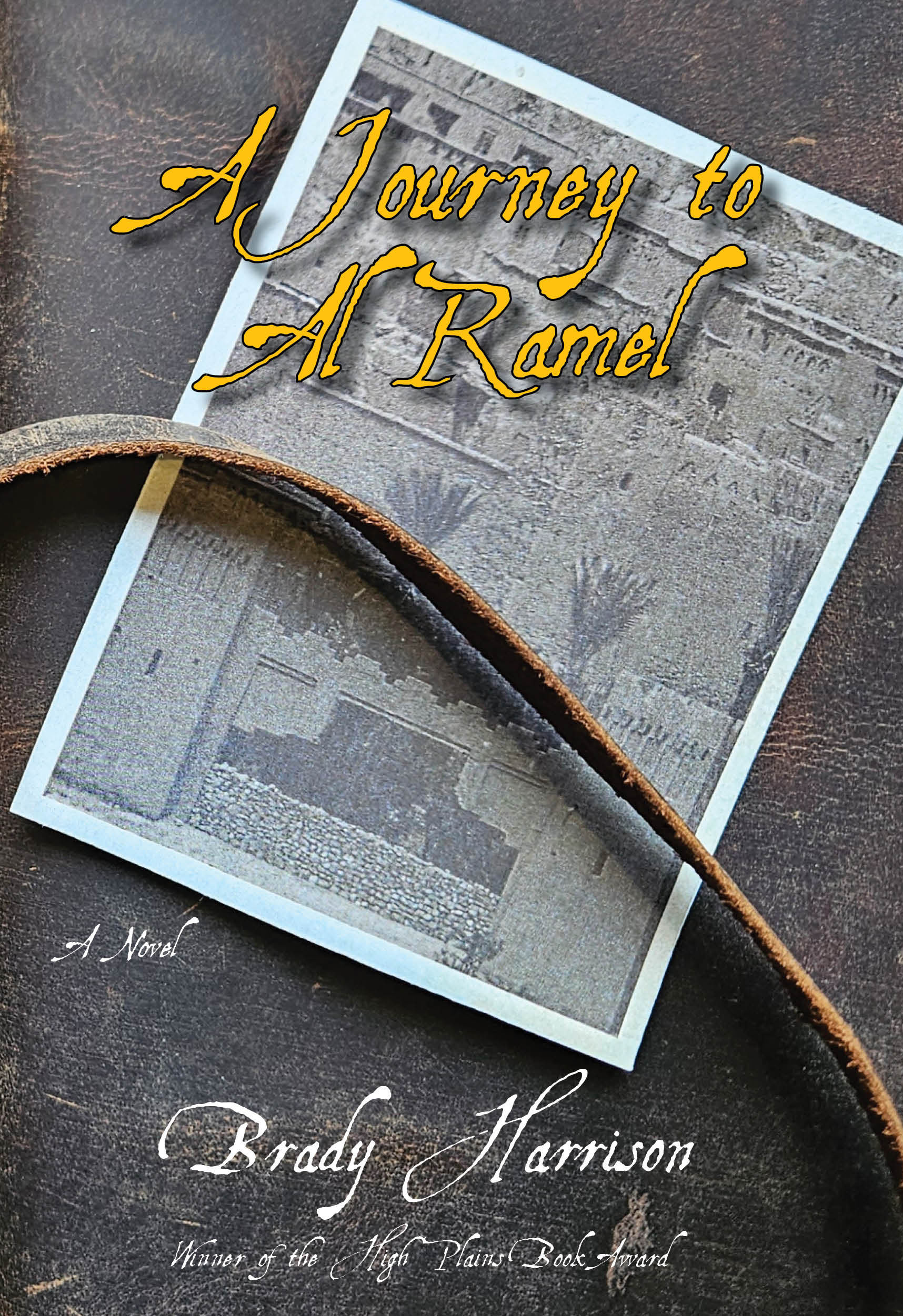
It has been a busy summer for both Brady and me, so finding opportunity to do this interview (even long distance) was also challenging. Among other things, Brady has been busy promoting his academic book (co-edited with Barry J. Faulk) Teaching Bob Dylan (Bloomsbury, 2024). I emailed Brady some questions regarding A Journey to Al Ramel and his writing process more generally. His responses will appear in full in the paperback edition of the novel. Here is an abridged version of the interview, which we conducted in July and August 2025—ever mindful of the fast-approaching academic year. In addition to being a short story writer, novelist and podcaster, Brady is Professor of Literature at University of Montana. (For more information about Brady’s work, visit his Twelve Winters webpage.)
I think it’s correct to say we’ve been talking about the novel that we’ve just published as A Journey to Al Ramel basically since you and I met when your novella “The Dying Athabaskan” won the Press’s Publisher’s Long Story Prize, which we brought out in 2018. Is that correct? More broadly, when did you begin work on A Journey to Al Ramel, and could you talk about some of the iterations that it went through?

Indeed, how long have I been working on what has become A Journey to Al Ramel? I first got the idea many years ago when I was living for the summer in San Francisco. Through an aunt, I had a card for the Mechanic’s Institute’s library—the building itself is a work of art, with a grand spiral staircase—and I would spend mornings at the library, reading adventure stories and travelogues and journals. It was an incredibly carefree time—my wife was attending an NEH summer program at Stanford—and I began to daydream of ways that I could bring together all these adventurers and exiles from different times and places into a single narrative. How could Burton be in a story with Nietzsche and Rimbaud and others? That summer, as I wandered through China Town and North Beach and farther afield, it all began to take shape: it didn’t matter if none of the historical figures my characters were based on had actually crossed paths: this would be a novel, something that would be wild, and the rules of time and space are no match for the imagination. Or, that was my idea, anyway.
Some years after that (I have a day job that keeps me busy), I sat down and began to write a tale of intertwining wanderers—all of whom were obsessed, who set out for faraway places (often for not very good reasons), and who were as wound up, restless, and unsettled as anyone you could imagine. The work went through a number of drafts—I’ve lost count—and when I was living in Ireland, I rewrote it from the first word to the last, and cut about 15,000 words (including a very violent and upsetting story written by Isabelle, in which St. Martin features as one of the characters, about a massacre in an underground cistern that I transposed from Istanbul to beneath Jemaa el-Fnaa, the famous square in Marrakesh’s medina. The story had to go: it was way too vicious, even for a narrative with its share of brutal events.)
I find your book extremely visceral: the heat, the sweat, the grit, pangs of hunger, thirst, exhaustion, the pain of illness and injury, primeval fear. I presume you haven’t experienced the same sort of things that your protagonist, Benard St. Martin, experiences (I’m hoping), so how did you channel those extreme conditions and their ill effects on Benard in order to write about them so effectively?
Funny. While it’s true that I have never experienced anything like what St. Martin goes through—fortunately—I did base the more realistic passages about his time in the desert not only on memoirs and journals of actual desert travelers, but also on my own experiences as an inveterate—ok, obsessed—hiker and backpacker. (I never seem to get enough of the mountains.) I remember, for example, a trip I took to Mt. St. Helens. A buddy and I drove from Missoula to Washington, and on that first evening, we explored the ill-named Ape Cave, a lava tube running beneath the volcano. The next day we climbed to the summit, and then spent three days circumnavigating the mountain, including a couple of days in the blast zone: all ash and rock and some scrub brush and no shade and no water save what you carry until you get all the way around to the Toutle River. It was a great, but very demanding trip, and it was hot and the trail—despite some cairns—was occasionally uncertain and by the time we descended the steep ridge of ash to the river, I was feeling pretty blasted by the sun and heat and I was dehydrated and weary and felt quite queasy.
I remember, too, that the immense spaces and strange topography of the blast zone put such a zap on my mind that when we got back to Missoula, I didn’t recognize my street. Of course, this is nothing compared to St. Martin’s adventure, but over the years I’ve had a few moments along the trail. And, I know from experience that if you head out for the wilderness often enough, sooner or later you might need a few stitches or some meds to calm your guts or an x-ray and a cast. As my daughter—someone who also likes adventures—says, these things happen.
The novel is set primarily in Morocco, in the Sahara, and I know you’ve visited Morocco. Which came first, your idea for the novel or your visit to Morocco? No matter the order, how did visiting Morocco influence your writing of the novel?
Ah! Right: I had the idea for the novel first, but there’s no way I could have written the book if I hadn’t traveled to Morocco. We can all make up a lot of stuff, but I have to have a sense of a place before I can write about (something like) that place. I have to have that visceral, granular experience. (I guess I’ll never write a story about living on a space ship?)
As a traveler and sojourner, I’ve noticed that my imaginings or daydreams about a particular place and its people and places often don’t match up very well to my experiences on the ground. Since I was in college, I wanted to go to Paris, and I read books set in Paris, watched films, looked at pictures, and studied French (in my case, a woeful pursuit), and when I finally got to Paris for the first time, the city exceeded all my expectations. It was grander and more monumental—it was way better—than my daydreams and imaginings. For me, it’s only when I’m in a place, seeing what I can see, taking in what I can of the overwhelming amount of information and people and details, that I can get a feel for that place. I wrote a story once, “It’s Not Like You Think,” and I’ve always taken that phrase as a sort of rule for life: how you imagine something—a place, an event, a person—very rarely corresponds to what it’s really like. Maybe that’s just me?
To bring my answer to your question back to A Journey, while the book makes no claims to historical, biographical, or geographical accuracy, I had to go to Marrakesh, had to travel south, had to see the desert and the mountains before I could write the novel. Yet I should be absolutely clear: there was lots of air conditioning, restaurants, comfy rooms in riads, and shopping in the souks. I did not try to go on a trip like St. Martin’s.
Anyone who follows our podcast knows what a devil of a time I had in laying out the book. Originally you included all kinds of intriguing (and unusual) textual features, most of which just wouldn’t work on the printed page. Therefore, we had to tone down most of the visual features you had in mind. Could you talk about your original vision for the book? Then also discuss how we went through the process of revising it, and how you felt about making such significant changes.
Is your question, What’s the best way to piss-off your publisher?!
Just playing.
In truth, the manuscript I originally sent you was the work of a madman. Wanting to play around with how the story looked on the page, I had all sorts of parallel narratives, blocks of words shaped like photographs, and narratives inside narratives inside narratives (and the different strands about each of the different characters were originally written in different fonts so that I could keep all moving parts straight for myself).
My idea was pretty simple, but as you patiently explained to me, what you can do on a computer screen doesn’t always translate to the page for publication. The idea was that the backbone of the overall narrative was a journal, told in daily entries, and that each of the other narratives, built around a different character and told in a different narrative style or form, would intrude and might push aside (for a time) the primary narrative.
Overall, it would become a sort of compendium of styles and genres and it was so much fun for me to play with all of that. I love voices and the “rules” of different genres and I became wound up with mimicking all sorts of forms: letters, lists, footnotes, boys adventure stories, travelogues, and more.
In the end, I had to unparallel the narratives—on the left would be a column continuing St. Martin’s journey toward Al Ramel; on the right might be an entry from Burton’s notebooks or a letter from a Rimbaud to his mother or a list of dirty words—and I think what we came up with works well (or I hope it does): it’s still a compendium of styles and forms and narratives intruding on one another, but without most of the graphic, visual complexity. I think it all makes its own sort of sense—I hope it does—and it’s certainly much more reader friendly.
Bottom line: I’ll never do any of that sort of thing again—unless I’m really trying to try your patience and get myself tossed from the Twelve Winters roster.
Along with the purely fictional characters, you bring in some real historical figures and incorporate them in to the narrative. What was your motivation behind that choice? How did you go about working some real people into the storyline?
Ok, this gets at the heart of why it took me so long to write (and rewrite the novel): although almost all of the characters are based, in some measure, on actual people, they are also very much not those people. This is neither history nor biography, but at the same time, I am very interested in all the figures in the book: why did they set out on their adventures, often at considerable peril to their lives? I was interested in these actual people and their actual journeys, but I also wanted the freedom to do impossible things.
And, like lots of readers, I enjoy stories that blend fact and fiction. I remember, when I was quite young, reading Nicholas Meyer’s The Seven-Per-Cent Solution: Sherlock Holmes meets Sigmund Freud? I was, at the time (and still) a huge fan of Conan Doyle’s Holmes stories, and I when I read Meyer I thought it was great: a fictional character meets an actual person and they have an adventure. And, we’ve all read historical novels—I read a lot of World War II novels, and Winston Churchill and other historical figures routinely show up—or seen movies like Oppenheimer or Lawrence of Arabia—they’re based on actual people and events but they’re also dramas, not documentaries—and I had all of those examples in front of me as I was working on A Journey.
Still.
What has given me pangs (and doubts) all along is that there is something different about basing a character on an actual person—someone who walked the earth, and might not want to become a character in your story—and creating a character with their own name and identity and backstory and more. I think it’s an ethical issue, one I wrestled with a lot. In the end I thought, ok, this is a work of fiction, it’s supposed to be a romp, a crazy tale about adventurers who are willing to go right to the ragged edges of experience, right to the limits of their endurance and ability to survive. Nobody will mistake this for reality.
What complicates all of this even more: any number of the historical figures I base the characters on were rotten people—a few, rumor has it, were murderers; Lawrence, if not a card-carrying fascist, held any number of reprehensible ideas—and you wouldn’t let them in your front door or near your kids.
Did I answer your question?
In my mind, the mixing of the real with the fictional is an iteration and amplification of one of the novel’s most significant themes: the difficulty in knowing what is real and what isn’t, what is genuine and what is fake—questioning the very concept of reality. Is this a fair reading of the novel? Or am I way off base?
Ok, now we’re talking!
In the most fundamental ways, if philosophers, psychologists, writers, physicists, and others are right, we are strangers to ourselves and strangers in a strange land, one we hardly understand or apprehend.
Whatever we may think of Freud, for example, I think we’d be hard pressed to argue against his notion of the conscious and unconscious parts of the mind. We hardly know where ideas come from, and do we really understand our desires and motivations? Do we know why we want what we want, and can we really say, always, that we know why we think and act as we do? Do we understand all the ways in which traumas and desires and all that’s stored in the unconscious exert pressure on our conscious, daily lives? Do we understand how the past shapes us or how all the immense systems that swirl around and through us affect our beliefs and behavior? Add to that that our memories are faulty and unreliable and that our senses are unreliable (and overwhelmed) and often just plain wrong, so how can we be sure about anything?
But it goes deeper than human problems or limitations. As anyone who knows me knows, I’m obsessed with quantum physics and general and special relativity (and small matters like time and time’s arrow). From reading Carlo Rovelli, Sean Carroll, Brian Greene, Neils Bohr, and others, we learn that the universe is a much stranger, much less certain place than we imagine. Subatomic particles are not little baseballs that behave like planets (or baseballs), but rather probabilities that seem not to be in a particular place, traveling at a particular speed, until somebody looks. As Rovelli says, reality is not what it seems and nobody, as far as I know, has yet reconciled quantum physics with relativity: What is gravity? What is time? (Rovelli says entropy is what we experience as time.) Does time only run in one direction? How does entanglement, or what Einstein called spooky actions at a distance, work, and how can particles share information seemingly faster than the speed of light? How did the unimaginably vast cosmos (some physicists think it might be infinite) come into being from a speck? (Given the mind-bendingly vast distances and the speed at which the universe is expanding, light from faraway will never reach us: we will never know just how vast the universe might be?) And, how come I’m so woeful at dating and why do I like potato chips so much and why is creation so dangerous?
To bring this all back to A Journey, since we hardly know ourselves or why we do what we do, and since we can barely understand creation, how can we be sure about anything or anyone, including ourselves? What ground can we stand on? And, it’s fun to unsettle folks: can the reader rely on what they’re being told? Can all of these incredible things really be happening? Is St. Martin just unhinged? My theory is that we cannot be sure about anything—that creation itself is shot through with uncertainty and chance—and I have a deep aversion to true believers, to people who hold too tightly to what they take to be certainties.
Is this a Gothic novel? That is, your love of the Gothic seems to come into play (in my view), including Gothic spaces and supernatural, even monstrous, elements. Are the Gothic elements a deliberate choice, or did they seep into the narrative of their own accord? Or do you disagree regarding what I identify as Gothic features in the novel?
Interesting. Is this a Gothic novel? Indeed, now that you mention it, there are many Gothic spaces and lots of seemingly supernatural, monstrous elements. I hadn’t really been thinking about the novel in those terms, but as you say, I love the Gothic (and routinely teach a course on The Brontës and the Gothic, where we read Walpole and Byron, then Jane Eyre and Wuthering Heights, and move from those absolute masterpieces to Dracula and short stories by Poe, Faulkner, Oates, Lovecraft, and others, and finish with Jean Rhys’ brilliant writing back, Wide Sargasso Sea.) So, my love of the Gothic has seeped into A Journey to Al Ramel—wow. Thanks for that great question: it has me thinking about how all the books (and movies and art and more) that we love might begin to speak in and through us.
You’re currently at work on a collection of stories that (as you say) are in conversation with Ernest Hemingway’s work. Again, on the surface, this project may seem a dramatic departure from A Journey to Al Ramel—yet I can see some connections and correspondences between the novel and this new work (for one thing, you say you bring Hemingway himself into the collection, as you have inserted real people into Al Ramel). Can you say a bit about this new project, and would you agree that there are some aspects of the novel in these Hemingway-inspired stories?
I do see A Journey to Al Ramel and the collection-in-progress, “At Gertrude Stein’s Grave,” as doing different things, even as, as you suggest, they both take up historical figures and their lives and turn them into fiction. The novel may be in conversation with the lives and works of adventurers, but it’s primarily interested in taking their experiences and possible motivations as the starting point for an adventure story with lots of strange goings on. It’s a meditation on what drives some people to extremes. At the same time, it’s not in conversation with, say, Women in Love or A Season in Hell; it’s about what drives some people to write or create compulsively and, simultaneously, to head, again compulsively, for the ends of the earth.
In contrast, the collection of Hemingway stories is very much in conversation with The Sun Also Rises, “Hills Like White Elephants,” and other of his most famous early works. It’s also in conversation—in all kinds of ways—with events and people from his life, including Stein and others. For my own part, I’ve always loved conversation pieces, where writers talk back and forth, sometimes taking the piss, trying to show who’s smarter or funnier or whatever. The most famous example of conversation pieces might be the many replies to Christpher Marlow’s “The Passionate Shepherd to His Love.” Sir Walter Raleigh, John Donne, C. Day Lewis, William Carlos Williams, Greg Delanty, and others all take their shot, and it’s a back and forth that has lasted centuries. Some even say that Mick Jagger and Keith Richards get in on the conversation in “Live with Me.” The Hemingway stories work in this tradition, and it’s all just for fun, even as some of the stories are very serious. We’ll see if it turns out.
The collection should be done this fall—fingers crossed—and then I have a novel in mind that begins in Sicily in 1944: it will not be in conversation with any real people or their works, of that I am sure.
Finally, I think all three of us who host the podcast take some ideas and inspiration from our conversations—I know I do. Can you point to anything that we’ve discussed in the podcast that has directly affected your writing or your ideas about writing?
Absolutely. I have learned so much from you and Grant, and how haven’t our conversations influenced my writing? The Hemingway stories, for example, go very much against the grain of my usual working habits—where I revise and revise and revise—and I’m trying to be looser and freer in writing the new stories. Grant has particularly influenced me in this regard, but your interest in Melville and Mary Shelley—and now Poe—and in conversation with Typee and Frankenstein has clearly given considerable energy to the novel and to “At Gertrude Stein’s Grave”: we love books and stories and we often write about writers and their lives and adventures and draw inspiration from their works. The podcast has been so much fun and I look forward to it each month. I’m not sure what our listeners may be getting from the conversation, but I’m all the time thinking about narrative strategies—compression, free indirect discourse, weaving experimental elements into largely realist stories, how to handle dialogue, how to build in (or leave out) historical research, and more—and how I might deploy them in my own work. It’s been invaluable—learning from your friends in an ongoing, genial conversation about writing, journals, books, writers, publishing, and teaching. (Grant and I would talk much more about hockey, if we could.) Folks: tune in to A Lesson before Writing!
▪ ▪ ▪
Ted Morrissey is the publisher of Twelve Winters Press and its various entities, including Twelve Winters Journal and the podcast A Lesson before Writing. His most recent books are the novel The Strophes of Job, and Delta of Cassiopeia: Collected Stories and Sonnets. Like the poet Carl Sandburg, he was born and raised in Galesburg, Illinois.
journal | miscellany | press | podcast | team
 Twelve Winters