
journal | miscellany | press | podcast | team
Commentary on “Train to West Ruislip”
Yura Riphyak
In the first drafts of “Train to West Ruislip,” there was a paragraph saying that a person living in a big city encounters between 85 and 360 strangers every day. This adds up to between 31,025 and 131,400 per year, and between 2,482,000 and 10,512,000 over a lifetime. Even if three-quarters of these encounters are with the same people, chances are that before we die, we meet enough strangers to populate a city the size of San Francisco. All these people are merely part of the ambiance: two-dimensional, like a Tom Cruise cutout in the foyer of your local cinema; besides, it doesn’t occur to us to snap a selfie with them.
And yet, from our own example, we know that inside each person is a universe. Each has desires, fears, victories, defeats, gratitudes, and grudges. Each has a movie she has watched eight times, a taste that brings back childhood memories, a dirty little secret, a battle she must fight, a place she wants to return to.
This contrast has fascinated me for years. I was thinking: what if there was an app that let you just point your phone at someone—and it would give you a Wikipedia article about them? And perhaps also a YouTube playlist of their memories, and a live feed of their thoughts? We don’t have an app like that yet—so instead, we buy books. Nothing interests us more than other people. In The Hunter-Gatherers Guide to the 21st Century, Heather Heying and Bret Weinstein suggest this has a lot to do with Homo Sapiens’ success as a species. We figured out how to gather into much larger groups than other animals, and the knowledge about every member was vital for the stability of the group.
In another book—The Better Angels of Our Nature—Stephen Pinker argues that reading was the main reason people became much less violent over the last three hundred years. Seeing the world through the eyes of another person induces empathy.
This is what I wanted the reader to feel. As we progress through each monologue, the four strangers cease to be such. We start caring for them—and we want them to get to know each other too, to see how they can help each other. But then the train arrives, and they all enter through different doors.
The ‘mini-Decameron’ of four strangers and the app are two of the three elements that survived from the initial idea, though the app morphed into its opposite—a dating website where people hide behind masks. The third element was the commute. Initially, it was a bus stop: late at night, in the rain. I think of a bus stop as a limbo: a place in-between. The light and the rain also create a theatrical atmosphere. A person steps in from the darkness—and then disappears again when her bus arrives. In Ukraine, they have these small yellow buses called “marshrutkas”— the cheapest means of public transport. The driver has a wooden box with clinking stacks of coins and pulls on a rope to close the door. There is no schedule whatsoever: you just wait and hope—and eventually, your marshrutka arrives.
I’m not exactly sure when the Ukrainian marshrutka became a London Underground train. There is a scene at the end of the first chapter where a giant, obscure mechanism hidden under the surface sets everything in motion: trains, buses, cabs, people, pigeons, doors of buildings—and also clouds, thoughts, and fates. A mechanism has to be designed by someone—which is obviously true for the characters: their stories are designed by the author. When I visualize the scenes from “Train” in my mind, I see a mechanical puppet theater with wooden dolls in bulging crocheted clothes rolling along lengthy slits in the tabletop.
“Train” was the second story I wrote in English. Before that, all my writing was in Ukrainian—and then I hadn’t written a single page for over eight years. Most of this time, I spent in the UK and the US, after moving to California in 2018. So, when I started writing again two years ago, to my great surprise, I found that English now feels more natural.
“Surprise” isn’t exactly the right word. I was terrified. It felt like a person who had lost their passport in an airport transfer zone.
In his interview with the Paris Review, Vladimir Nabokov mentions this loss of mother tongue. Wrong word again: he mourns it. Nabokov was 38 when he moved to the US—the same age I resumed my writing. The difference is, by then he had published six novels in Russian. Still, after some time in emigration, Russian started to lose its depth for him.
The interview took place in 1968, 13 years after Lolita was published, and yet he says English still feels stiffish and artificial—”enough for describing a sunset or an insect, but which cannot conceal the poverty of syntax and paucity of domestic diction when I need the shortest road between warehouse and shop.”
I think Nabokov’s opulent language in Lolita was a sort of overcompensation. I read his earlier Russian novels, like Invitation to a Beheading or The Luzhin Defense—and you can already hear the music in the sentences, but it’s nowhere near the baroque splendor of Lolita. Discovering the new shades, harmonies, and overtones in the English language must have given him entomological pleasure—like catching an unknown species of butterfly.
I felt a similar pleasure writing the second and third stories. Researching contemporary British slang in Guy Ritchie movies and diving into the Oxford Dictionary for the pearls of refined upper-class English of Chelsea and Belgravia were equally rewarding.
But it wasn’t Nabokov who helped me regain my confidence; it was Bukowski. Bukowski could write something like, “We were sitting and drinking. Then Larry came along and brought some beer. So we drank some more.” — and it’s magical; you just cannot put it down! I binge-read Ham on Rye, Factotum, and Women, as if they were one book — which they are — and realized that language is not that important. What is important is whether your reader believes you. And also—whether your words can take your reader to a place they have never been before—like a long-awaited train.
▪ ▪ ▪
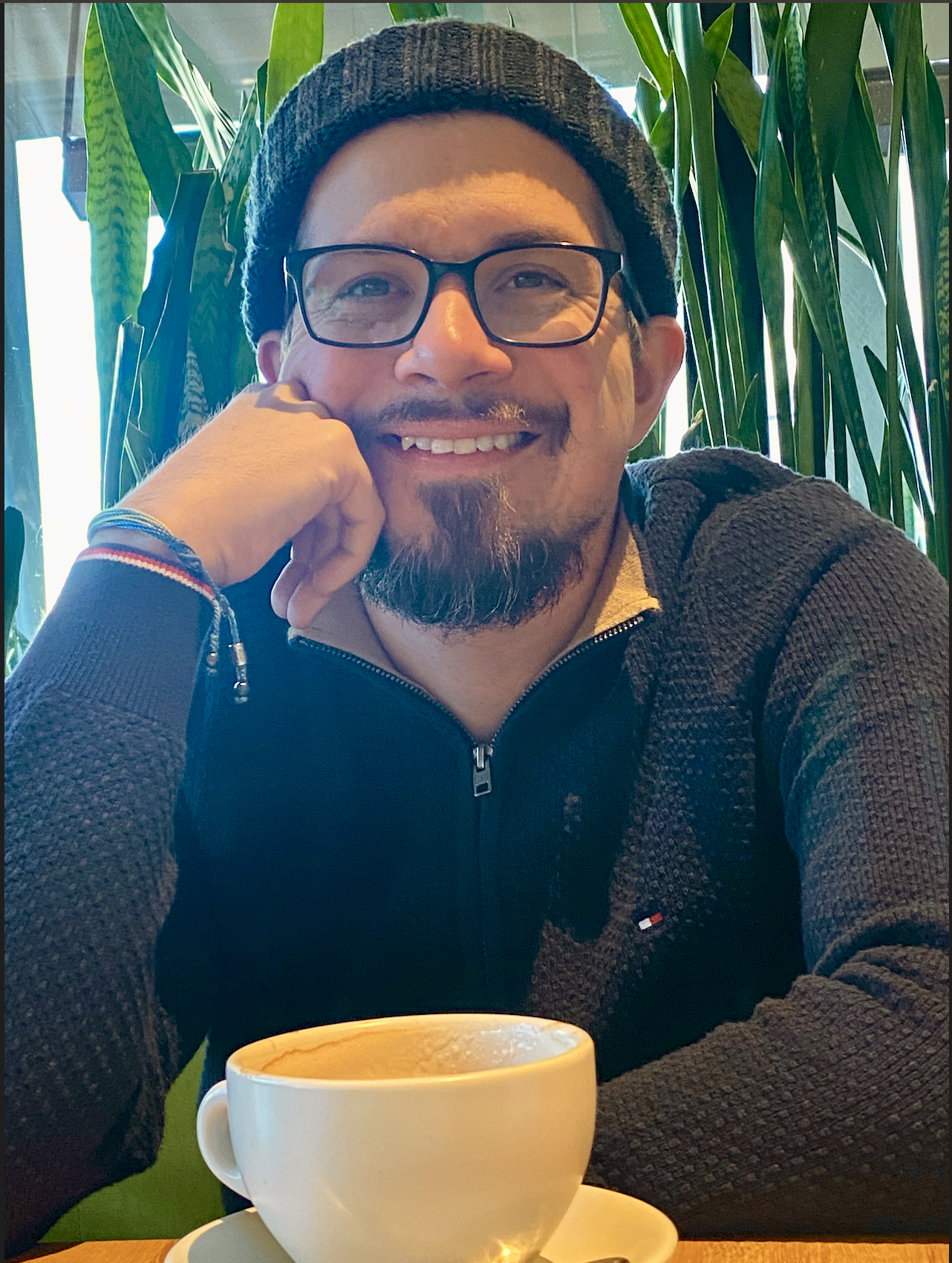
Born in Ukraine, Yura Riphyak holds an MA in Pharmacy with a focus on Drug Discovery, as well as a Diploma from the London School of Economics. While studying in London, he co-founded a software development company with a former jazz musician. One of their first projects was an anonymous dating app. Yura currently lives in the Bay Area, California, working in the field of Artificial Intelligence. His stories have previously appeared in Eclectica Magazine and Black Sheep Magazine.
journal | miscellany | press | podcast | team
 Twelve Winters