
journal | miscellany | press | podcast | team
Commentary on “Fish out of Water”
Thomas Wright
The outline of “Fish out of Water” was told to me thirty years ago by my uncle, over a pint in a English pub. Above the late evening hubbub of the saloon bar, through a yellow fug of fag smoke, he narrated an anecdote about a removal-man mate of his who’d been involved in a road accident on a job, caused by a diabetic client fainting at the wheel of a hire van. The accident had left his mate in the middle of a busy road with an enormous fish tank in his lap and a sizeable amount of explaining to do to the police …
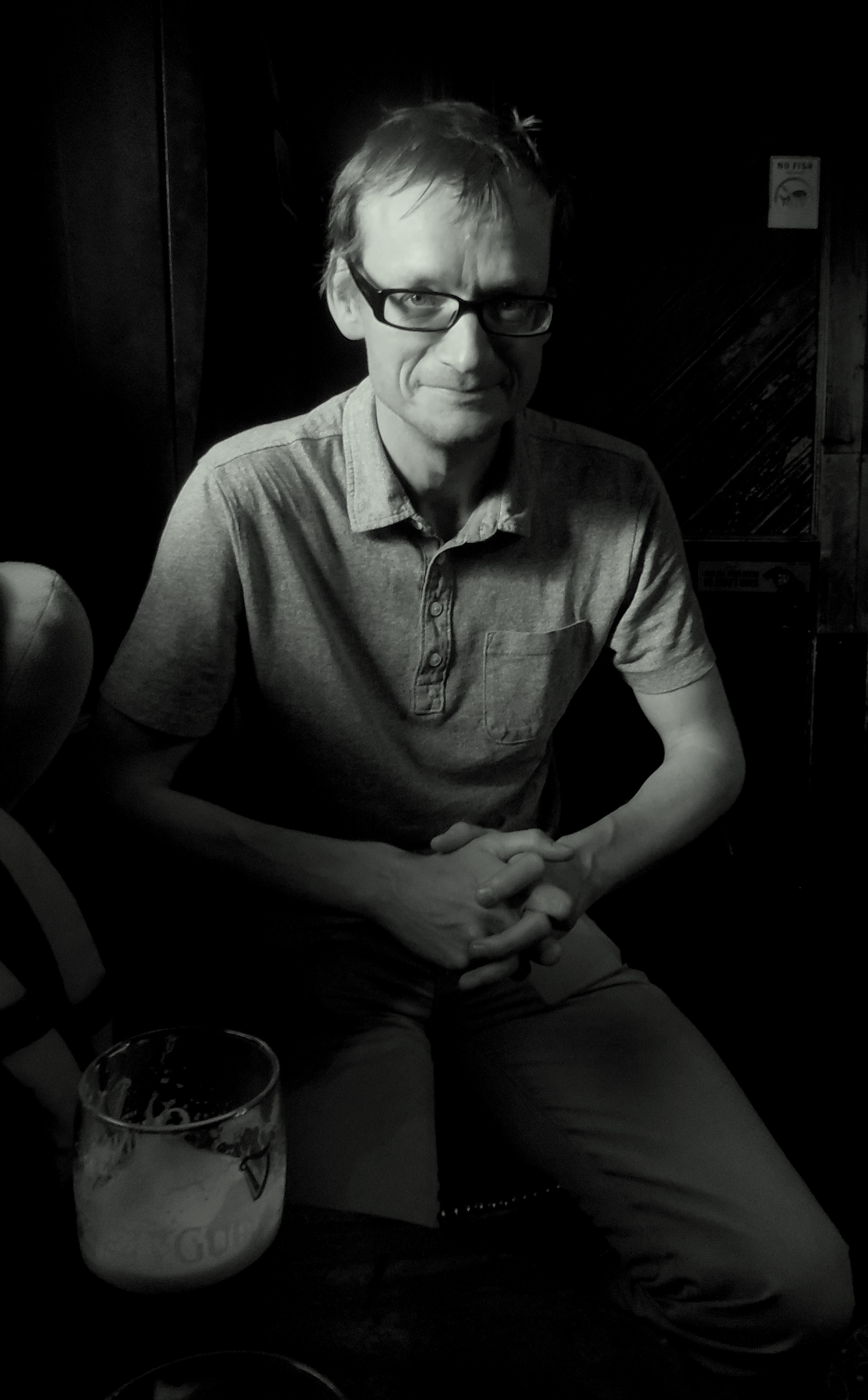
My uncle accompanied his yarn with a racy, ironic commentary, and a series of theatrical gestures and facial expressions – a twisted smile here, a tilt of the head there, to conjure up the hero as he stumbled through a succession of absurd scenes. I saw the story vividly, in my mind’s cinema, as slapstick or screwball surrealism – the Keystone Cops meet Dali and Dr Seuss, and get on hilariously. At the end of his performance, I wept with laughter into my Guinness, and resolved to write down the story someday. But how?
There seemed no point trying to reproduce, let alone rival, in writing, my uncle’s virtuoso third-person oral narration (though I did want to retain some of its fluid and fizzy verbal flavour). In any case, I thought a third-person narration might distance my reader from the action, and – for reasons I’ll explain – I wanted to plonk her down in media res, and keep her there, ‘in the midst of things’. So I opted for a first-person narration, with an oral timbre to it, delivered by a character whose perspective wouldn’t be omniscient like my uncle’s, but that of someone entangled in the incidents he describes.
My narrator/protagonist would be working-class, because English removal men invariably are. Like my uncle, he’d be articulate, verbally agile, and intelligent; and, like several people I’d known at school, and while working on a building site in my teens, he’d speak outer-London slang in an ersatz cockney accent. In composing the monologue of my quick-witted ‘mockney geezer’ (as people who talk this argot are known), I’d draw on the work of Charles Dickens, whose writings I devoured in the late nineties. I think Dickens’s lower-class monologists – Mr Magsman, ‘Doctor’ Marigold et al – are among his finest creations. For me, Boz is ‘inimitable’ as a fiction author when he writes ‘in character’, and especially in working-class characters (and abominable when he pontificates in the part of that self-important personage, the author Charles Dickens, Esquire). I decided to make my narrator a Dickens fan too, partly to acknowledge my debt to ‘Boz’, but also to emphasise how much more literate my hero is than the posh client and jobsworth policeman he encounters on his removal job, despite occupying a much lower social position than these wealthy and powerful people. (I invented these two characters to make this point, as well as for the sake of counterpoint). I also wanted to remind readers that Dickens wrote for lower-class people like my removal man, at a time of rapidly expanding literacy and education in England – a country very different from the one afflicted by a ‘literacy crisis’ today.
So, by around the year 2000, I had the bare bones of a droll story, and an arresting ‘Dickensian’ voice to narrate it in, and three colourful, complementary characters. And yet, it was only last year that I started the arduous process of putting it down in black on white. That wasn’t down to laziness, I hope, or the fact that I’ve only recently acquired experience as a fiction writer; it was also a matter of knowing when the time, as well as the tale and the teller, were ripe. What I mean is, some stories gain resonance from the context in which they’re read, and I think mine has more urgency and relevance now than it would have had if it appeared in print twenty five, or even ten, years ago. At the risk of sounding like Dickens in pontificating mode, I’ll try to explain why I think this.
Back in the 1990s, there were many articulate and literate working-class voices in the English media and in print; nowadays, however, they’re rarely heard. Voices like my narrator’s threaten a status quo in which working-class people are allotted a subordinate position, supposedly because of their inferior merits, but actually because of restricted opportunities. Thirty years ago, England also seemed a much securer place to those of us lucky enough to belong to the middle class (as a white, male, heterosexual member of that caste, I was particularly fortunate). In that relatively comfortable context, to such readers, a story about a removal job that goes horribly wrong would have read like madcap surrealism – funny ha ha because it was so funny peculiar – just as it seemed to me when I heard it in the pub. But now England (and the west generally) is a much madder, and darker, place, even for the middle classes, characterised by creeping (or rather marching) neo-fascism, ever grosser inequality, injustice, racism, misogyny and the ‘enshittification’ of public services and culture. In such a context, the tale seems emblematic rather than eccentric, and reads like gritty realism.
So, oppressive contemporary reality prompted me to write this old spoken story down. It also encouraged me to emphasise it’s representative and baleful qualities. Since road rage is now endemic in England, I introduced a violent argument between the narrator and some delivery men. Because you can be arrested in the country today simply for holding up a cardboard protest sign, my hero is harassed by a policeman who’s desperate to arrest him on a (T)rumped-up charge. I also depicted two of the great plagues of our time – addiction to Smartphones and Artificial ‘Intelligence’. I decided my narrator-protagonist would be driven mad – or at any rate to distraction and ‘unreliability’ – by the madness of his experience.
I wanted to dump my reader ‘in the middle’ of this mess (hence my decision to use the first person) – to make her feel it was the kind of mess she might find herself in, at any moment of any day in such an atomized place and time – to suggest that an enraged reaction to such experiences wasn’t disproportionate, or a deranged one surprising – that, in the mad world we’re now living in, all sane people feel like fish out of water…
Even if I didn’t succeed in provoking such thoughts and feelings in the reader, I was sure that penning the tale would be beneficial for me. It would make me feel slightly less helpless in the face of an everyday reality that’s sometimes overwhelming, as though I was doing something, however small, to resist it.
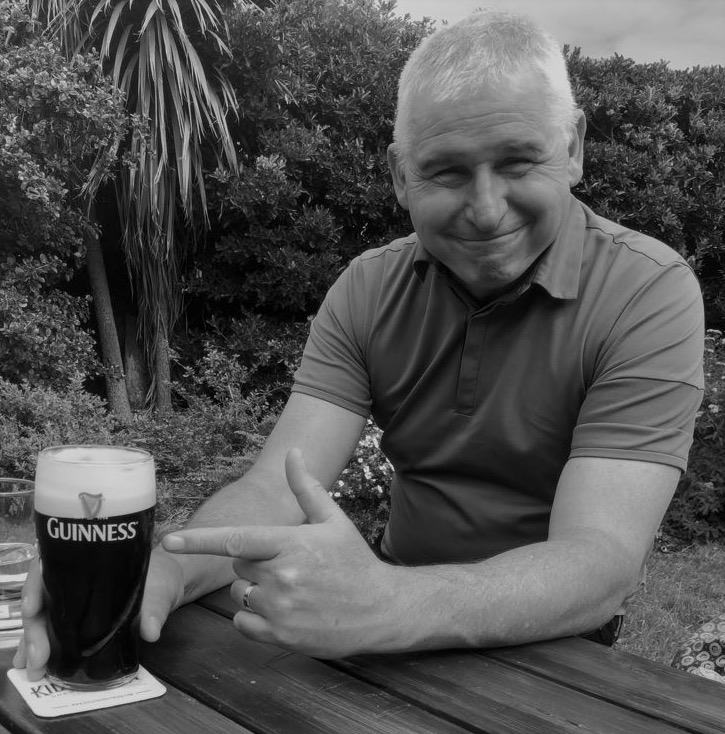
Once I started writing the story, I couldn’t stop. That may be due to the sense of urgency shared by the author and the narrator, but it’s also something that tends to happen when one writes in character. The writer feels relived at no longer being her (sometimes tiresome) self, and the character won’t shut up, so the writing becomes automatic, a kind of transcription. These fits of facility feel fun, and empowering, while they last, but they can also lead to facile writing. A lot of sober editing needs to be done after the intoxicated scribbling – in the end, it’s not putting black upon white that’s arduous, but rubbing out the grey bits. The first draft of this story was around 6000 words. I edited it down to under 3000, in a bid to make it readable. At that point I sent it off to my uncle, to bring the story full circle, by returning it to its original teller, as well as to get his opinion. I’m proud to say he enjoyed it, because he’s a star raconteur, and because he sowed its seed back in 1990s England – that a galaxy, far, far away.
▪ ▪ ▪
Thomas Wright’s play Death in Genoa was performed in London and Genoa, and made into an online audio-drama starring Simon Callow (listen for free here). His non-fiction books include Oscar’s Books (US title Built of Books: How Reading Defined the Life of Oscar Wilde), and Circulation (US title William Harvey). He has written documentaries for BBC Radio, articles for the Times Literary Supplement and the Independent, and fiction for The Brussels Review, The Rumen and TrashLight Press.
journal | team | miscellany | podcast | home

