
journal | miscellany | press | podcast | team
Commentary on “Gone with the Swallows”
Sante Matteo
The swallows of my childhood were propelled into the skies of my memories by several converging currents: first, a post-Covid visit to my hometown with my son, daughter-in-law, and two grandsons; second, the recent publication of a series of poems about my childhood in that small agricultural town in southern Italy; and third, participation in an international project, Forced Migration and the Arts, which includes the presentation and discussion of poetry about migration.
First: A month-long trip to Italy with my son and his family was planned for June 2020, when my two grandsons would have been 8 and 5 years old. The Covid pandemic forced us to postpone that visit to the summer of 2023, when we spent several days in my hometown, Petrella Tifernina, already known to my son, but never before visited by the rest of his family. During that visit, my grandkids’ reactions, observations, and questions prompted me to look at the town through their children’s eyes and to re-evoke my own childhood experiences, as I pointed out where and how life had occurred. Their children’s perspective of that world was superimposed on the palimpsest of my own childhood view, inducing me to gauge how I and that world had changed from generation to generation.
Second: Not long after that trip, my son, Nicholas, took up some poems I had written to my mother half a century ago, in the mid-1970s. In 8 poems—or 8 segments of what could be considered one long fragmented poem–written in Italian, collectively titled “Paesaggi con figura di madre” (Landscapes with Mother Figure), I recalled events and situations from my childhood, during the years from 1954, when my father emigrated to the United States with a work visa, when I was 5 years old, to June 1958, the year when the rest of the family—my mother, my younger sister, and I—were allowed to join him, when I was a month short of ten.
The poems were written specifically to, for, and about my mother, with no thought that they could ever be published. Decades later, after my mother died in February 2018 (on my wife’s birthday), I came across them again among the documents she had saved. To remember and commemorate her life, I shared them with friends and family. Some of them assumed they had been published, and others thought they should be.
Eventually, intrigued by these glimpses into his father’s childhood, my son adopted them and resuscitated those childhood events and emotions by translating the poems into English. Consequently, all 8 of the forgotten, half-century-old, never-meant-to-be-published poems ended up being recently published in side-by-side Italian and English versions: four in the Journal of Italian Translation (Fall 2024), three in the International Poetry Review (2026), and one in Gradiva: International Journal of Italian Poetry (Spring 2026).
Re-reading, discussing, and editing the poems throughout the process of translation and publication rekindled nostalgic memories of my childhood, including those of the swallows that nested under the eaves of our roof and glided, swooped, and flitted across the sky over our town.
Third: More recently, I submitted poems for the Africa Migration Report Poetry Anthology Series and have participated in several online seminars and presentations of the poetry. The poems and the topics discussed deal, primarily and specifically, with migration out of Africa but, ultimately and generally, with migration from anywhere to anywhere, and with today’s world made up of many diasporas.
My interest in the topic(s) results from a focus of my academic research: historical and cultural relations between Italy and Africa, particularly in modern literature and cinema: a topic addressed in an international symposium I organized and hosted in 1998, which spawned two books I edited: one in Italian, Africa Italia: Due continenti si avvicinano, 1999, and one in English, ItaliAfrica: Bridging Continents and Cultures, 2001. In the introductions to the books, and in other essays and presentations, I argue that the African and European tectonic plates come together at the Alps, not the Mediterranean Sea, and that, therefore, geologically speaking, the Italian peninsula is the northernmost part of Africa, and to be born in Italy is to be born in Africa, and as an Italian, I am also an African.
In the poem I submitted for one of the anthologies, “Continental and Human Drift,” I recall that all Earth’s continents drifted, or migrated, away from what would have been the middle, or heart, of Pangaea, the original, lone continent on the planet; and, eons later, all humans also migrated out of Africa, which, geologically, biologically, and culturally, is the “heart of it all.” We are thus all part of the African diaspora: continents, life, people.
Another poem I submitted and subsequently discussed included the image of the swallows of my childhood that migrated annually from my hometown to Africa and back. Those discussions led me to consider what is lost and what is gained in migration, be it voluntary or forced, and what is kept, abandoned, adapted, or renewed in history’s and the world’s many diasporas.
▪
Finally: After briefly sketching out an outline of this commentary, with brief allusions to the points made above, I put the notes on the proverbial back burner for a few months, until I could find the time and motivation to flesh them out.
Now that I’ve returned to those comments, however, it occurs to me that those experiences and recollections I’ve recounted above, significant and germane as they undoubtedly were, are nonetheless more like the icing on a cake that is still baking (to stick with a culinary metaphor, along the lines of that proverbial “back burner,” albeit “migrating” from the stovetop down to the oven below), rather than the cake itself. Or (to move metaphorically and culinarily closer to my own “home” turf), they are like the toppings on the pizza dough that is being rolled out and tossed about in the news these days, of which the main ingredient seems to be our current preoccupation with, fear and resentment of, and opposition to migration. These apparently widespread attitudes and policies appear (to me at least) to be a rather radical backlash against and/or betrayal of prior widely held beliefs, behavior, and laws, resulting nowadays in a fairly pervasive acceptance and promulgation of anti-migrant sentiments, policies, and legislation, and leading to frequent acts of individual and collective violence on many levels and stages: local, national, and international.
More than indulging in nostalgic reminiscence, I wanted to point out that migration is “natural,” practiced by many species, including swallows and humans, and that, ultimately, we are all “migrants” through life, whether we translocate or not. We all end up living in a different environment and a different community than the ones in which we started, if not spatially and geographically, then chronologically, socially, and technologically. For everyone, even those who have spent their entire lives within the same walls, the world in which we find ourselves today is not the same world in which we lived yesterday. As we navigate through our world’s rapidly evolving humanscape, we all become relative strangers in a relatively strange land.
The differences and the strangeness we inevitably confront are especially noticed and felt by those of us who have traversed more decades of life, for whom the long-ago world in which we were children learning to become humans becomes ever more remote with each passing year—and yet, no matter how remote, never entirely forgotten or abandoned: still rooted in us, as we are rooted in it.
These were (some of) the ingredients that came together, clashed, mixed, blended, and coalesced into the thoughts, concerns, and hopes expressed in the pizza—oops, sorry for that slip of the tongue (on those too-slippery metaphors); of course, I meant “the piece” (or did I?)—published in Twelve Winters.
▪ ▪ ▪
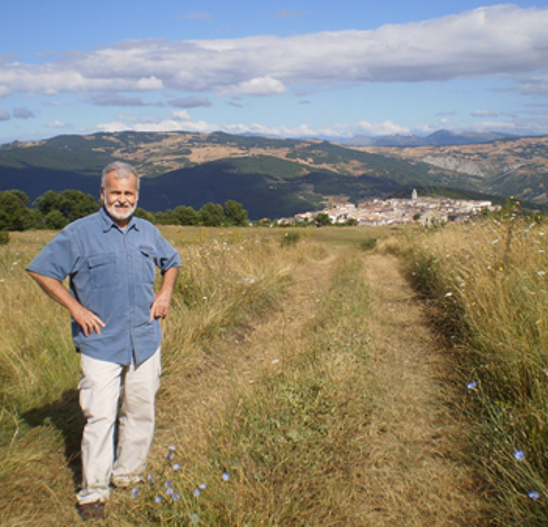
Sante Matteo was born and raised in a small agricultural town in southern Italy (in the background of his photo) and emigrated to the United States with his family as a child. He maintained his ties to Italy as a professor of Italian Studies. He is currently Professor Emeritus at Miami University, in Oxford, Ohio, where he resides, reminisces, and writes. Stories, poems, and memoirs have appeared in various journals, including previous issues of Twelve Winters Journal. Some can be found on his website: santematteo.com.
journal | team | miscellany | podcast | home

